The Guild Review is a blog of art, culture, faith and politics. We seek understanding, not conformity.
Showing posts with label Britain. Show all posts
Tuesday, May 24, 2016
Empire, Brexit, and the Historical Imagination
Today is Queen Victoria's birthday, a public holiday in Canada (observed on the preceding Monday) and the anchor point for the moving Empire Day holiday (which subsequently morphed into Commonwealth Day).
Debates about the British Empire - was it a monument of civilization or a system of global oppression? - have reminded me of debates about a more contemporary question: Brexit. Does Britain belong in Europe or not?
In a recent Financial Times article, Gideon Rachman examined the claims of two rival camps of historians as they argue about whether Britain has, historically, been part of Europe. Historians for Britain, the euro-skeptic party - led by David Abulafia, professor of Mediterranean history at Cambridge - contend that Britain has a long tradition of political continuity and moderate reform (unlike Europe, with its revolutions and reactions, not to mention Fascism, Nazism, and Communism), as well as physical separation from the European continent.
The pro-European party - which lacks a handy label, but did put out an article titled "Fog in Channel, Historians Isolated" - takes issue with these claims, noting that Britain has a long history of close interactions with the Continent. Not least among such linkages is Christianity, integral to Britain's identity, at least until quite recently, but also something to which Britain has no unique claim, but instead shares with the rest of Europe and regions beyond. Moreover, the critics note that Britain had a civil war, which, though several centuries ago, was no less nasty for its antiquity. So Britain is not immune to such upheavals. And then there's the Empire. "Expropriation, slavery, massacres, oppression, anyone?” asks Neil Gregor, professor of modern history at Southampton.
Rachman concludes that "I do not entirely agree (or disagree) with any of the historians I have met... [but] I agree with Abulafia and the Historians for Britain in one important respect: their argument that the UK has been unusually good at creating successful political institutions and that this is an inheritance worth cherishing and protecting." However, Rachman adds: "But I do not think that this adds up to an argument for Britain leaving the EU."
I would like to pull the lens even further back, so to speak. Ever since Leopold von Ranke (1795-1886), the father of the modern historical craft, we - I say this as a member of the historical guild - have focused on history wie es eigentlich gewesen (as it actually happened). This is a perfectly reasonable and laudable standard for historians to pursue. But as Friedrich Nietzsche (1844-1900) reminds us, history also has advantages and disadvantages for life. I would not go so far as to say, as Nietzsche might, that we should falsify the historical record for the sake of the impact it has on the present. But we would be fools to overlook the role that perceptions of the past have in shaping our imaginations, which in turn shape our actions.
In this context, I would argue that emphasizing Britain's long history of evolving, moderate, and generally freedom-loving political institutions is useful, even inspiring, for Britain's present, whether that be within or outside the EU. In a similar vein, I think a case can be made that emphasizing the British Empire as a global effort at fostering trade, harmonizing law, ensuring security, and spreading the Gospel is a worthy means of inspiring the men and women of today to deeds of virtue.
You might contend that these visions of Britain's past are as much romance as fact; I would suggest they are simply the product of particular emphasis. But what about all the failures that went along with these positive elements? Ah, you are putting on your critical history hat, as Nietzsche would say. As I pointed out five years ago, we can do that tomorrow. Today we celebrate the good.
Today's image comes from the Canadian War Museum.
Saturday, November 28, 2015
Muslims in the GOP
Is this the face of a conservative Muslim politician? Turns out, it is. Cemile Giousouf was elected to German's Bundestag (federal parliament) in 2013, the chamber's first Muslim representative of the conservative Christian Democratic Union party. As the Financial Times pointed out at the time, she is an example of a small but growing number of European Muslims who are abandoning the continent's secular left-wing parties because they feel more at home with Christian conservatives. In Britain, Sayeeda Warsi grew up in a Pakistani-British family and was appointed Vice Chairman of the Conservative Party in 2005. Two years later she was created Baroness Warsi and became the youngest member of the House of Lords.
Here in the US, the story is a bit different. It's not that there's a shortage of pro-life, pro-marriage, faith-infused, free trade, limited government, robust national security-minded Muslims out there. The Republican Muslim Coalition and its president, Saba Ahmed, for example, embody just such values. No, the problem is that the likes of Donald Trump and the populist wing of the party seem to be doing their best to alienate such potential voters, as the FT reports. In 2000, George W. Bush won 42% of the American Muslim vote, a hefty piece of a growing pie (and probably one of the Republicans' strongest showings among any minority group). By 2008, 89% of Muslims were voting Democrat.
Back home in Arizona, I frequently voted for Mormons, not because I share all their theological beliefs, but because I found that I shared political and social values with many Mormon candidates. I'd be happy to vote alongside Muslims and for Muslim candidates as well, if only the GOP doesn't drive them all away.
Photo credit: Kölner Stadt-Anzeiger.
Wednesday, November 5, 2014
What Guy Fawkes Day Means to Me
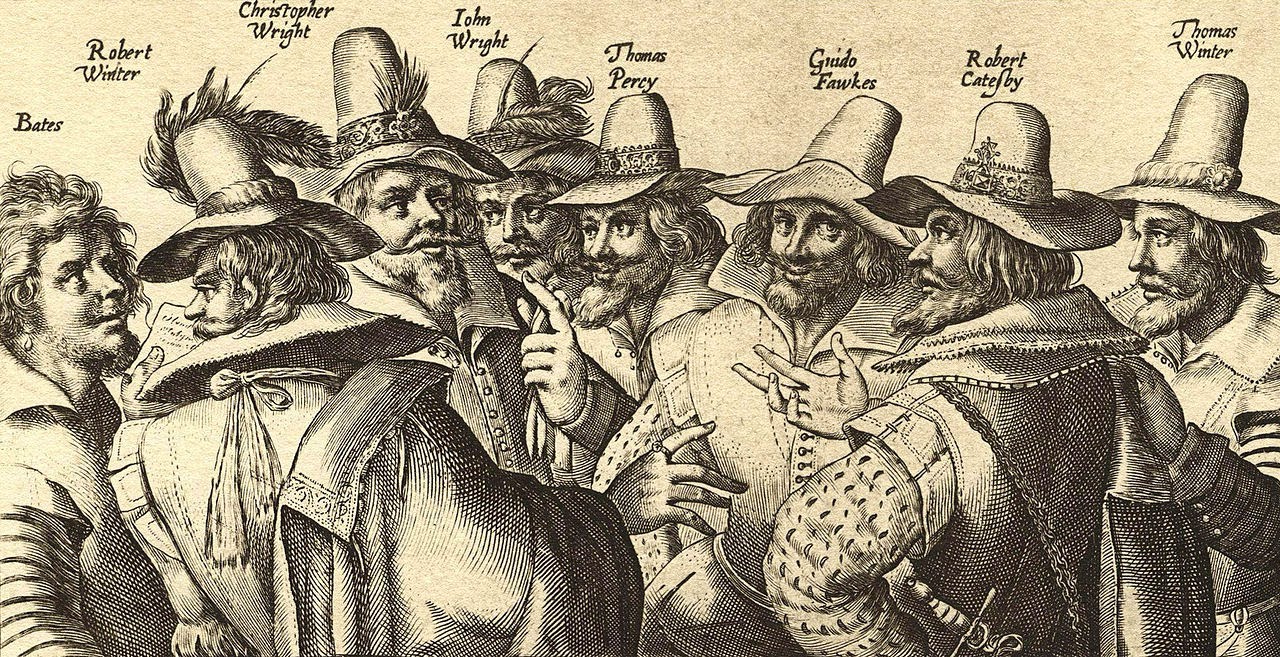
Guy Fawkes Day, also known as Bonfire Day, is a curious holiday. It commemorates the failure on 5 November 1605 of the Gunpowder Plot, a scheme by a group of Catholics to blow up parliament and the Protestant King James I. The plotters were betrayed, the barrels of gunpowder under the House of Lords were discovered in time, and the king's life was spared.
I find this a curious occasion to commemorate because it conforms neither to the major trend in holidays, nor to the primary exception. Most holidays celebrate glorious triumphs such as victories in battle (e.g. Lepanto Day / Feast of the Holy Rosary), political successes (usually independence), or momentous spiritual events (e.g. the Incarnation or the Resurrection). Some holidays, such as Thanksgiving, do not celebrate a particular triumph, but point to successes generally. Apart from this major trend of celebrating victory, there is an exceptional category of holidays, which recall tragic failures, either gloriously defiant (e.g. the Alamo or the July 20 Conspiracy), or horrors from which we have, broadly speaking, taken some meaning or learned some lesson (e.g. Good Friday, September 11th, or Memorial Day).
But why do the English celebrate Guy Fawkes Day? One might say it has become little more than an excuse for fireworks and bonfires, and this is probably true, but it only pushes the question to one step remove: why this day, and not some other? The failure of the Gunpowder Plot was as much the fault of bumbling plotters as it was as success for the Crown and its supporters. More to the point, the Plot was defeated not in honest battle or by national effort, but by shadowy intrigue. Hardly the stuff of most victories.
Sadly, the real reason Guy Fawkes Day may have caught on in England is that it offered a chance to spite Catholics. Indeed, the centerpieces of Guy Fawkes celebrations has traditionally been the burning in effigy of Mr. Fawkes and the pope. Although other figures are often substituted today, this makes the holiday more than a tad bit awkward for Catholics.
But I have come to see the need for a third kind of holiday, the commemoration which does not yet possess resolution. Perhaps my recent excursions into the historical books of the Old Testament have pushed me in this direction, for they are mostly filled with rebellions, defeats, and exile, epitomized by Psalm 137: "By the waters of Babylon, / there we sat down and wept, / when we remembered Zion. / On the willows there we hung up our lyres. / For there our captors / required of us songs, / and our tormentors, mirth, saying, / 'Sing us one of the songs of Zion!' / How shall we sing the Lord’s song / in a foreign land?" We have a small appetite for commemorating such events when they are recent, though memory quickly fades. But history is replete with such calamities. The burden of history, though it need not be overwhelming, certainly rests heavy on us, if only we open our eyes to see it.
For me, Guy Fawkes Day commemorates the difficulty of living in the world but not of it. It commemorates the confusion that results when trying to square the demands of eternal faith with the demands of temporal politics. It commemorates well-intentioned devotion gone awry. It commemorates the reality that my co-coreligionists have undertaken actions I cannot always explain or justify. It commemorates divided Christendom. This is, or should be, a painful open wound. Although there are lessons to be learned, I do not think we are yet at the point where we can say that we have learned them. For now, we must simply recall. We must bear the weight of history and trust that wisdom, some day, will follow.
![]() |
| Members of the Gunpowder Plot |
But why do the English celebrate Guy Fawkes Day? One might say it has become little more than an excuse for fireworks and bonfires, and this is probably true, but it only pushes the question to one step remove: why this day, and not some other? The failure of the Gunpowder Plot was as much the fault of bumbling plotters as it was as success for the Crown and its supporters. More to the point, the Plot was defeated not in honest battle or by national effort, but by shadowy intrigue. Hardly the stuff of most victories.
![]() |
| Guy Fawkes Day, Lewes, England, 2011 |
But I have come to see the need for a third kind of holiday, the commemoration which does not yet possess resolution. Perhaps my recent excursions into the historical books of the Old Testament have pushed me in this direction, for they are mostly filled with rebellions, defeats, and exile, epitomized by Psalm 137: "By the waters of Babylon, / there we sat down and wept, / when we remembered Zion. / On the willows there we hung up our lyres. / For there our captors / required of us songs, / and our tormentors, mirth, saying, / 'Sing us one of the songs of Zion!' / How shall we sing the Lord’s song / in a foreign land?" We have a small appetite for commemorating such events when they are recent, though memory quickly fades. But history is replete with such calamities. The burden of history, though it need not be overwhelming, certainly rests heavy on us, if only we open our eyes to see it.
For me, Guy Fawkes Day commemorates the difficulty of living in the world but not of it. It commemorates the confusion that results when trying to square the demands of eternal faith with the demands of temporal politics. It commemorates well-intentioned devotion gone awry. It commemorates the reality that my co-coreligionists have undertaken actions I cannot always explain or justify. It commemorates divided Christendom. This is, or should be, a painful open wound. Although there are lessons to be learned, I do not think we are yet at the point where we can say that we have learned them. For now, we must simply recall. We must bear the weight of history and trust that wisdom, some day, will follow.
Friday, March 28, 2014
Toward a Theory of American Heraldry
Readers of this blog will know that I am a strong proponent of heraldry, having proposed heraldic arms for the City of Charlottesville (see left) and Albemarle County, to complement or replace the current seals of questionable aesthetic merit. But does heraldry have a place in America at all? Are not heraldic arms associated with monarchy and therefore fundamentally at odds with the American republic?
First, the legal question: Can an American assume arms? In many countries, such as Britain, arms are legally protected. They may only be used by a grant deriving its authority from the sovereign. In other countries, such as South Africa, the governing authority registers arms, but, provided they conform to certain standards, cannot reject an application because it does not grant the arms; everyone in South Africa has a legal right to bear them. In the United States, no heraldic authority of either flavor exists (the claims of various online organizations notwithstanding). Thus, the only legal limits on arms are those on any logo: you cannot use for commercial purposes a design that someone else has registered. You can use your own design without registering it, provided you are not concerned about someone else stealing your design and have no intention of taking legal action against them for doing so.
Second, the historical angle: Do American have a tradition of using arms? Here the answer is clear: yes. While American heraldry is less standardized than that of Britain or other countries with heraldic authorities, it is widely used. George Washington's arms are fairly well known (see left), having been adopted for a variety of uses such as the flag of the District of Columbia and the Purple Heart medal. Thomas Jefferson, one of the more anti-traditional of America's Founding Fathers also bore arms. John and John Quincy Adams utilized heraldic arms, as did most of the signers of the Declaration of Independence. But, you ask, is there still a vibrant tradition of heraldry, or was it only a brief carry-over from the colonial period? One could likely write a dissertation on such a question, though it seems to me the US military provides a strong answer in the affirmative. Heraldry may not be used in every aspect of everyday life, but for certain purposes we certainly retain it. (I highly encourage the perusing of the US Institute of Heraldry's website if you have any interest in military heraldry.)
Third, the ideological angle. Just because Americans have used heraldry does that mean they should? Is is truly consonant with America's republican constitution? Here I think we have to step back from Britain and its heraldic world, much though I love it. When one does so, one discovers that in much of Europe heraldry had little to do with the sovereign. In Germany, Switzerland, and the Netherlands, burgher arms were assumed by various members of what we would call the middle class: merchants, artisans, clergy, and the like. Similar practices can be found in Scandinavia, were farmer have also traditionally borne arms. Thus, heraldry has no fundamental connection to a monarchy and why should it? Heraldry is simply a method of visual representation of individuals or organizations. That non-noble heraldry has a long tradition in the German-speaking world is no minor point for the United States; German-Americans constitute the largest single ancestry group in the country and the Declaration was translated into German even before it was passed.
Thus, there is no reason that any American, so inclined, should not assume arms.
But what are the proper sources for such arms? In one sense, the same answers given elsewhere apply in the US: symbols associated with one's place of origin or residence, profession or interests, or visual puns (canting). I might add that one should draw on such associations as one deems appropriate. If you care deeply about genealogy, use the traditional heraldic colors of your country of origin. But if you couldn't care less about your umpteen greats grandfather, find something else to depict.
But there is a more tricky matter: how does one indicate familial connections? British heraldry, and most other systems, has methods for handing down arms from parents to children (usually fathers to sons). But in America, status is - in republican principle, at least - held by virtue of one's innate human nature and one's role as a citizen, not by birth. So should, for example, a son use his father's arms, differenced with the appropriate mark of cadency? Certainly, if one wanted to strongly stress a familial connection, one could do so, though I would certainly not want to require it. Moreover, I think it runs contrary to our republican spirit - not to mention basic creativity - to forgo modifying inherited arms. Nevertheless, experience shows that we all owe a great deal to our parents, for both good and ill, so if they bear arms, one would do well to incorporate elements from those arms into one's own.
A related matter concerns marshalling, that is, the combining of arms. Typically a married couple will place their arms side by side (no objections here) and their eldest son will quarter his parents' arms. I have two objections with quartering. First, it tends to become very cluttered very quickly, rarely working beyond a single generation, and often not even then. Aesthetically it is often a failure. (See, for example, the unnecessarily cluttered arms of Mary and Philip, above left, or William and Mary, right.) And what is the point of heraldry if it is not clearly identifiable? Second, quartering again presumes the inheritance of arms. I think it far more interesting and American for each individual to design his or her own.
Some final considerations: While Americans are not bound by the laws of other countries, they would do well to respect them. Thus, I would strongly discourage any American from copying outright arms which are registered not only here, but also abroad. This is bad taste and runs contrary to the fundamental heraldic notion of unique identification. Moreover, I would encourage Americans to avoid those symbols which are typically reserved elsewhere (e.g. the use of royal crowns) and use cautiously those elements of heraldry - such as supporters and standards - which are sometimes associated with special privileges. Perhaps the most common error in this regard concerns the heraldry of Scottish clans. Americans often assume that, having a certain surname, they belong to the corresponding clan and therefore have a right to use its arms. Not so. Under Scottish law, arms belong to the chief of a clan; members of the clan, that is, the chief's supporters, use a crest badge. So don't go plagiarizing any Scottish chiefs. It's rude.
While I cannot make promises on the timing, several more posts regarding heraldry are in the pipes, and I hope to expound on these ideas further in the context of some examples.
First, the legal question: Can an American assume arms? In many countries, such as Britain, arms are legally protected. They may only be used by a grant deriving its authority from the sovereign. In other countries, such as South Africa, the governing authority registers arms, but, provided they conform to certain standards, cannot reject an application because it does not grant the arms; everyone in South Africa has a legal right to bear them. In the United States, no heraldic authority of either flavor exists (the claims of various online organizations notwithstanding). Thus, the only legal limits on arms are those on any logo: you cannot use for commercial purposes a design that someone else has registered. You can use your own design without registering it, provided you are not concerned about someone else stealing your design and have no intention of taking legal action against them for doing so.
Second, the historical angle: Do American have a tradition of using arms? Here the answer is clear: yes. While American heraldry is less standardized than that of Britain or other countries with heraldic authorities, it is widely used. George Washington's arms are fairly well known (see left), having been adopted for a variety of uses such as the flag of the District of Columbia and the Purple Heart medal. Thomas Jefferson, one of the more anti-traditional of America's Founding Fathers also bore arms. John and John Quincy Adams utilized heraldic arms, as did most of the signers of the Declaration of Independence. But, you ask, is there still a vibrant tradition of heraldry, or was it only a brief carry-over from the colonial period? One could likely write a dissertation on such a question, though it seems to me the US military provides a strong answer in the affirmative. Heraldry may not be used in every aspect of everyday life, but for certain purposes we certainly retain it. (I highly encourage the perusing of the US Institute of Heraldry's website if you have any interest in military heraldry.)
Third, the ideological angle. Just because Americans have used heraldry does that mean they should? Is is truly consonant with America's republican constitution? Here I think we have to step back from Britain and its heraldic world, much though I love it. When one does so, one discovers that in much of Europe heraldry had little to do with the sovereign. In Germany, Switzerland, and the Netherlands, burgher arms were assumed by various members of what we would call the middle class: merchants, artisans, clergy, and the like. Similar practices can be found in Scandinavia, were farmer have also traditionally borne arms. Thus, heraldry has no fundamental connection to a monarchy and why should it? Heraldry is simply a method of visual representation of individuals or organizations. That non-noble heraldry has a long tradition in the German-speaking world is no minor point for the United States; German-Americans constitute the largest single ancestry group in the country and the Declaration was translated into German even before it was passed.
Thus, there is no reason that any American, so inclined, should not assume arms.
But what are the proper sources for such arms? In one sense, the same answers given elsewhere apply in the US: symbols associated with one's place of origin or residence, profession or interests, or visual puns (canting). I might add that one should draw on such associations as one deems appropriate. If you care deeply about genealogy, use the traditional heraldic colors of your country of origin. But if you couldn't care less about your umpteen greats grandfather, find something else to depict.
But there is a more tricky matter: how does one indicate familial connections? British heraldry, and most other systems, has methods for handing down arms from parents to children (usually fathers to sons). But in America, status is - in republican principle, at least - held by virtue of one's innate human nature and one's role as a citizen, not by birth. So should, for example, a son use his father's arms, differenced with the appropriate mark of cadency? Certainly, if one wanted to strongly stress a familial connection, one could do so, though I would certainly not want to require it. Moreover, I think it runs contrary to our republican spirit - not to mention basic creativity - to forgo modifying inherited arms. Nevertheless, experience shows that we all owe a great deal to our parents, for both good and ill, so if they bear arms, one would do well to incorporate elements from those arms into one's own.
A related matter concerns marshalling, that is, the combining of arms. Typically a married couple will place their arms side by side (no objections here) and their eldest son will quarter his parents' arms. I have two objections with quartering. First, it tends to become very cluttered very quickly, rarely working beyond a single generation, and often not even then. Aesthetically it is often a failure. (See, for example, the unnecessarily cluttered arms of Mary and Philip, above left, or William and Mary, right.) And what is the point of heraldry if it is not clearly identifiable? Second, quartering again presumes the inheritance of arms. I think it far more interesting and American for each individual to design his or her own.Some final considerations: While Americans are not bound by the laws of other countries, they would do well to respect them. Thus, I would strongly discourage any American from copying outright arms which are registered not only here, but also abroad. This is bad taste and runs contrary to the fundamental heraldic notion of unique identification. Moreover, I would encourage Americans to avoid those symbols which are typically reserved elsewhere (e.g. the use of royal crowns) and use cautiously those elements of heraldry - such as supporters and standards - which are sometimes associated with special privileges. Perhaps the most common error in this regard concerns the heraldry of Scottish clans. Americans often assume that, having a certain surname, they belong to the corresponding clan and therefore have a right to use its arms. Not so. Under Scottish law, arms belong to the chief of a clan; members of the clan, that is, the chief's supporters, use a crest badge. So don't go plagiarizing any Scottish chiefs. It's rude.
While I cannot make promises on the timing, several more posts regarding heraldry are in the pipes, and I hope to expound on these ideas further in the context of some examples.
Wednesday, December 25, 2013
Peace on Earth
In December 1914, Pope Benedict XV called for a truce amid the bloodshed of the Great War, to offer some respite and "cease the clang of arms while Christendom celebrates the Feast of the World's Redemption." The governments of Europe refused.
But a curious thing happened: On Christmas day, hundreds of thousands of soldiers laid down their arms, climbed out of their trenches, and celebrated together. Songs were sung, small gifts exchanged. The recent dead were buried. Joint services were held to mark the holiday. Modern British Christmas traditions - such as Christmas trees and many carols - are German in origin, so the festivities naturally overcame linguistic barriers. In some sectors of the Western Front the truce lasted an entire week.
It is difficult to pin down what sparked this spontaneous celebration. Pope Benedict's appeal likely had little direct effect. The unofficial truce may simply have been the response of exhausted soldiers to the horrors of war. But many, perhaps most, of these men were Christians, of one denomination or another. It is striking that, in the midst of one of humanity's most terrible conflicts, in the midst of a conflict which nearly tore European civilization apart, in the midst of a conflict which no one seemed able to halt, grown men, surrounded by the carnage of death, paused to celebrate the birth of a little baby, the Prince of Peace.
Though "the nations protest and the peoples conspire in vain, [though] kings on earth rise up and princes plot together against the Lord and against His anointed one" (Psalm 2:1-2), may God, in His mercy, fill our hearts and our world with His peace this Christmas.
This image of soldiers from the 134th Saxon Regiment and the Royal Warwickshire Regiment together on St. Stephen's Day (26 December) 1914 comes from the Imperial War Museum's collection, via Wikipedia. If you have never visited the IWM, you should.
Saturday, September 21, 2013
Remembering Hugh Seagrim
Tomorrow marks the sixty ninth anniversary of the death of Major Hugh Seagrim. Born in 1909, Seagrim attended the Royal Military Academy at Sandhust and joined the British Indian Army and then the Burma Rifles. As a young officer, Seagrim practiced the official religion of the British Army: lapsed Anglicanism.
In January, 1942, the Japanese Army invaded Burma. Several months before the invasion an Assistant Superintendent of the Burma Frontier Service began organizing and training guerrillas. Seagrim, who had become fluent in several Burmese languages, was recruited and formed a guerrilla force of Karens, one of the loyal hill tribes.
The Karens are a curious people. Wedged between the Thais and the Bamar (the dominant ethnic group in Burma), the Karens have long struggled to exert their own identity. Nineteenth century European anthropologists suspected that the Karens might be a lost tribe of Jews: they worshiped a single god, Y'wa. The story goes that Y'wa had three sons, a Karen, a Bamar, and a pale son. To each he gave a copy of his laws: the Karen received the laws on tablets of gold, the Bamar and the pale son on tablets of lesser materials. When the Bamar lost his tablets, he tried to steal those of the Karen, who in turn entrusted them to his pale younger brother. The pale brother sailed off to the west with the golden tablets, promising to return with Y'wa's laws some day. So when Christian missionaries arrived in Burma, they found many Karens ready to welcome them with open arms; after all, they were the decedents of their little brother, returning with God's law. As a result of missionary work by American Baptists, as well as Catholics and other Protestant denominations, approximately 15% of Karens came to accept the Christian faith.
While in the jungle of the Karen Hills, plotting attacks on Japanese convoys and trying to maintain contact with the outside world, Seagrim rediscovered his Christian faith. He and his men - who affectionately referred to the 6' 4" British officer as "Grandfather Longlegs" - would read the Bible together and pray before turning to their work of resistance. The extent to which his new-found love of Christ infused his life and work is best exemplified by his death.
Seagrim's Karen forces were a major thorn in the side of Burma's Japanese occupiers. So much did the Japanese fear him that they undertook a major effort to find and capture him. But Seagrim enjoyed the support of the local Karen population and had a superior command of the local geography. He always remained ahead of his would-be captors. Frustrated by their failures, the Japanese began undertaking a tōbatsu, a "punitive expedition", into the Karen Hills. Hundreds of villagers were arrested and tortured. Many died for their refusal to reveal Seagrim's location.
In the end, Seagrim, sickened by the destruction being visited on the people he had come to love, saw only one way to end the violence: by giving himself up. So on 15 March 1944 he surrendered to the Japanese. He was taken to Rangoon, where he was sentenced to death, along with eight of the Karens with whom he worked. Seagrim begged for their lives, arguing that they had merely followed orders, and that the responsibility for resistance activities had been his. But Seagrim's companions - much less their Japanese captors - would hear none of it; they were fiercely loyal and vowed to die with him. Seagrim was killed on 22 September 1944.
In 1985, the Karens gave a plaque to Seagrim's native village in England:
Hugh Seagrim and his brother Derek, who won the Victoria Cross in another theater of the Second World War, are also remembered on the village sign:
Those interested in Major Hugh Seagrim can read more in Ian Morrison, Grandfather Longlegs: The Life and Gallant Death of Major H. P. Seagrim, G.C., D.S.O., M.B.E. (London, 1947).
Today's image of Major Seagrim comes from the Karen Heritage website.
In January, 1942, the Japanese Army invaded Burma. Several months before the invasion an Assistant Superintendent of the Burma Frontier Service began organizing and training guerrillas. Seagrim, who had become fluent in several Burmese languages, was recruited and formed a guerrilla force of Karens, one of the loyal hill tribes.
The Karens are a curious people. Wedged between the Thais and the Bamar (the dominant ethnic group in Burma), the Karens have long struggled to exert their own identity. Nineteenth century European anthropologists suspected that the Karens might be a lost tribe of Jews: they worshiped a single god, Y'wa. The story goes that Y'wa had three sons, a Karen, a Bamar, and a pale son. To each he gave a copy of his laws: the Karen received the laws on tablets of gold, the Bamar and the pale son on tablets of lesser materials. When the Bamar lost his tablets, he tried to steal those of the Karen, who in turn entrusted them to his pale younger brother. The pale brother sailed off to the west with the golden tablets, promising to return with Y'wa's laws some day. So when Christian missionaries arrived in Burma, they found many Karens ready to welcome them with open arms; after all, they were the decedents of their little brother, returning with God's law. As a result of missionary work by American Baptists, as well as Catholics and other Protestant denominations, approximately 15% of Karens came to accept the Christian faith.
While in the jungle of the Karen Hills, plotting attacks on Japanese convoys and trying to maintain contact with the outside world, Seagrim rediscovered his Christian faith. He and his men - who affectionately referred to the 6' 4" British officer as "Grandfather Longlegs" - would read the Bible together and pray before turning to their work of resistance. The extent to which his new-found love of Christ infused his life and work is best exemplified by his death.
Seagrim's Karen forces were a major thorn in the side of Burma's Japanese occupiers. So much did the Japanese fear him that they undertook a major effort to find and capture him. But Seagrim enjoyed the support of the local Karen population and had a superior command of the local geography. He always remained ahead of his would-be captors. Frustrated by their failures, the Japanese began undertaking a tōbatsu, a "punitive expedition", into the Karen Hills. Hundreds of villagers were arrested and tortured. Many died for their refusal to reveal Seagrim's location.
In the end, Seagrim, sickened by the destruction being visited on the people he had come to love, saw only one way to end the violence: by giving himself up. So on 15 March 1944 he surrendered to the Japanese. He was taken to Rangoon, where he was sentenced to death, along with eight of the Karens with whom he worked. Seagrim begged for their lives, arguing that they had merely followed orders, and that the responsibility for resistance activities had been his. But Seagrim's companions - much less their Japanese captors - would hear none of it; they were fiercely loyal and vowed to die with him. Seagrim was killed on 22 September 1944.
In 1985, the Karens gave a plaque to Seagrim's native village in England:
Hugh Seagrim and his brother Derek, who won the Victoria Cross in another theater of the Second World War, are also remembered on the village sign:
Those interested in Major Hugh Seagrim can read more in Ian Morrison, Grandfather Longlegs: The Life and Gallant Death of Major H. P. Seagrim, G.C., D.S.O., M.B.E. (London, 1947).
Today's image of Major Seagrim comes from the Karen Heritage website.
Wednesday, March 27, 2013
The Paintings of James Tissot
Thanks to the Financial Times I discovered the works of James Tissot (1836-1902). This Franco-British artist came from a background of textiles and ships, both of which feature in his works. His painting verges on the impressionistic, but remains a tad too literalist to bear that label.
Tissot was born into a devout Catholic family, drifted away from the faith and into a liaison with an Irish divorcee, and eventually underwent a re-conversion to the religion of his youth. His paintings display a vitality one might easily associate with either romantic liaison or sacramental reality, depending upon the circumstances.
Like so many of his contemporaries - from the Belgian Jan August Hendrik, Baron Leys (1815-1869) to the Anglo-Dutch Sir Lawrence Alma-Tadema (1836-1912) and the Turkish Osman Hamdi Bey (1842-1910) - Tissot tends to paint small groups of people in scenes which tell a story and take place in a setting which is itself a kind of secondary subject. But unlike Leys or Alma-Tadema, who painted extensively from history, Tissot focused on contemporary scenes, except late in his life when Biblical themes predominated.
I'll not go so far as to claim that Tissot is a genius, an artist for the ages. His works are charming, though probably not sublime. Still, I am glad for having stumbled upon them.
Today's images come from the ever-ready Wikipedia.
Tissot was born into a devout Catholic family, drifted away from the faith and into a liaison with an Irish divorcee, and eventually underwent a re-conversion to the religion of his youth. His paintings display a vitality one might easily associate with either romantic liaison or sacramental reality, depending upon the circumstances.
Like so many of his contemporaries - from the Belgian Jan August Hendrik, Baron Leys (1815-1869) to the Anglo-Dutch Sir Lawrence Alma-Tadema (1836-1912) and the Turkish Osman Hamdi Bey (1842-1910) - Tissot tends to paint small groups of people in scenes which tell a story and take place in a setting which is itself a kind of secondary subject. But unlike Leys or Alma-Tadema, who painted extensively from history, Tissot focused on contemporary scenes, except late in his life when Biblical themes predominated.
I'll not go so far as to claim that Tissot is a genius, an artist for the ages. His works are charming, though probably not sublime. Still, I am glad for having stumbled upon them.
Today's images come from the ever-ready Wikipedia.
Wednesday, October 5, 2011
Red Beans & Rice - an American Odyssey
This is not a recipe blog. However, I spent a goodly while in Britain over the past few months, as this blog bears out. I wrote about my favorite British regiments, observed Empire Day, did some hypothetical casting for a movie about Brits, celebrated an English saint and reflected upon a British philosopher of history. A raging Anglophile I may be, but all this talk of Britain got me a little concerned. Am I not American? Is everything simply better over there? Does America have nothing I want to celebrate?
As these questions rolled around in my mind, I was struck by one particularly American aspect of my life: food. Many of the foods I make on a regular basis are staples of "traditional" American menus. A fair number actually have their roots in other countries or cultures, though they have been adopted with typically American assimilation. Likewise, most of these recipes came to me through a mix of family, cook books and good old tinkering. Perhaps the same results could have come about in another place, but these foods and their stories strike me as quintessentially American. And so I plan to share a few.
Today's recipe has a slightly odd genesis. I began making beans and rice because it was cheap, filling and kept well. I just threw together some ingredients. If there was any inspiration, it was probably my father's Ham & Beans recipe. But this was certainly a different creation, a vaguely Southwestern dish for the hungry bachelor. But after I got married, I discovered that my wife - whose mother is from Mississippi and whose father is from Louisiana - expected "beans and rice" to be New Orleans-style red beans and rice. With the guidance of her poking and a few pointers from my mother-in-law, my bachelor recipe evolved into something of which I am rather proud. It looks more Southern than Southwestern now, but I think it retains hints of its origins (in both my homeland and my hungry bachelor phase). Enjoy!
Red Beans & Rice
3 cups dry beans (I often use one each of kidney, small red and pinto beans, but sometimes I use black too)
2 cans diced tomatoes (I usually use one "Mexican style" and one with green chilis)
14 oz kielbasa sausage, sliced
1 large onion, chopped
1 green pepper, chopped
1 Tbsp minced garlic
2 Tbsp ketchup
2 Tbsp Worcestershire sauce
1 Tbsp brown sugar
2 tsp vinegar
1 tsp salt
1/2 tsp black pepper
Soak beans overnight or quick soak (ie, bring to rolling boil, turn off and let soak for 1 hr). Begin simmering beans with tomatoes and lots of water. Saute sausage, onion, green pepper and garlic in vegetable oil. Add sausage mixture and remaining ingredients to beans. Cook until beans are tender (2-3 hrs, usually). Serve over rice.
Unfortunately, no, today's picture is not of my own making. It comes from Simply Recipes.
Monday, July 4, 2011
Our Lives, Our Fortunes and Our Sacred Honor
Nevertheless, though I may be an Anglophile (as any reader of this blog could fast discern), and one currently in Britain, today is a day for remembering when the British were in the wrong, denying British subjects their due rights. But the full splendor of Independence Day is not simply the winning by Americans of their due rights as subjects. Nor is it simply a commemoration of the blood, sweat, toil and tears which Americans shed to secure those rights. (Yes, I stole that line from Sir Winston. No, he would not mind. Yes, I'm happy to let him have it back on any other day.) What American Independence Day truly is - or ought to be - about are universal rights. That was the great insight of the American Founders: that their cause, though just within the terms of the British legal tradition, was ultimately about natural rights, rights given by God.
This year I have omitted the list of grievances, fun though the repetition of "He has..." may be. But here is the rest of the Declartion's text. Give it a moment's consideration:
* * *
When, in the course of human events, it becomes necessary for one people to dissolve the political bands which have connected them with another, and to assume among the powers of the earth, the separate and equal station to which the laws of nature and of nature's God entitle them, a decent respect to the opinions of mankind requires that they should declare the causes which impel them to the separation.
We hold these truths to be self-evident:
That all men are created equal,
That they are endowed by their Creator with certain unalienable rights,
That among these are life, liberty and the pursuit of happiness,
That to secure these rights, governments are instituted among men, deriving their just powers from the consent of the governed.
That whenever any form of government becomes destructive to these ends, it is the right of the people to alter or to abolish it, and to institute new government, laying its foundation on such principles and organizing its powers in such form, as to them shall seem most likely to effect their safety and happiness.
Prudence, indeed, will dictate that governments long established should not be changed for light and transient causes; and accordingly all experience hath shown that mankind are more disposed to suffer, while evils are sufferable, than to right themselves by abolishing the forms to which they are accustomed. But when a long train of abuses and usurpations, pursuing invariably the same object evinces a design to reduce them under absolute despotism, it is their right, it is their duty, to throw off such government, and to provide new guards for their future security. --Such has been the patient sufferance of these colonies; and such is now the necessity which constrains them to alter their former systems of government. The history of the present King of Great Britain is a history of repeated injuries and usurpations, all having in direct object the establishment of an absolute tyranny over these states. To prove this, let facts be submitted to a candid world....
In every stage of these oppressions we have petitioned for redress in the most humble terms: our repeated petitions have been answered only by repeated injury. A prince, whose character is thus marked by every act which may define a tyrant, is unfit to be the ruler of a free people.
Nor have we been wanting in attention to our British brethren. We have warned them from time to time of attempts by their legislature to extend an unwarrantable jurisdiction over us. We have reminded them of the circumstances of our emigration and settlement here. We have appealed to their native justice and magnanimity, and we have conjured them by the ties of our common kindred to disavow these usurpations, which, would inevitably interrupt our connections and correspondence. They too have been deaf to the voice of justice and of consanguinity. We must, therefore, acquiesce in the necessity, which denounces our separation, and hold them, as we hold the rest of mankind, enemies in war, in peace friends.
We, therefore, the representatives of the United States of America, in General Congress, assembled, appealing to the Supreme Judge of the world for the rectitude of our intentions, do, in the name, and by the authority of the good people of these colonies, solemnly publish and declare,
That these united colonies are, and of right ought to be free and independent states;
That they are absolved from all allegiance to the British Crown, and
That all political connection between them and the state of Great Britain, is and ought to be totally dissolved; and
That as free and independent states, they have full power to levy war, conclude peace, contract alliances, establish commerce, and to do all other acts and things which independent states may of right do.
And for the support of this declaration, with a firm reliance on the protection of Divine Providence, we mutually pledge to each other our lives, our fortunes and our sacred honor.
Today's image is John Trumbull's Surrender of Cornwallis at Yorktown.
Wednesday, June 29, 2011
Future Casting
If ever someone makes a movie about the founding of Britain's Special Operations Executive, Joan Bright Astley, who was a secretary at one of SOE's precedessor agencies, should be played by Carey Mulligan. The resemblance is striking.

Wednesday, April 13, 2011
My Favorite British Regiments
Having recently been in Britain for a spell, studying military history, I have decided that it is high time to choose some favorite regiments.
If this strikes you as something completely foreign to your own experience, let me suggest an analogy: it is as though I have been a huge fan of college football for several years, but have no school I call my own, no team I really pull for.
Before I continue, let me anticipate an objection. "Why favorite regiments (plural!)?" you ask. A fair question, but one easily answered. How many favorite college football teams do I have? Several. Nebraska (my father's home state) and Texas A&M (my current school) top the list, but my wife's family are affiliated with Mississippi State and I have various connections to Arizona State and Kansas as well. Can they all be favorites? There might need to be a hierarchy, but college football is big enough that these teams rarely play one another (except within the Big 12, especially the North, but Nebraska's departure changes that). So, yes, one may have several favorite football teams. Considering that there were scores and scores of regiments - 100, perhaps? - during the Great War, I think a couple favorites is allowed. Even today there are 17 infantry regiments, plus 12 cavalry regiments and Territorial and support units, in the British Army.
As previously discussed on this blog, my family's Scottish heritage is a bit of a mystery. Are we from the western Isles or from the border, near Dumfries? Rather than choosing between them, I embrace both. Now, these two regions correspond to two regiments: from the Isles we get the Seaforth Highlanders (pictured left, advancing across France in 1944), and from the border we of course get the King's Own Scottish Borderers (KOSB - cap badge pictured right). The former was formed in 1881 (though by amalgamating two similar regiments raised in 1778 and 1793 to fight the French), while the latter was raised in 1689 to fight against James II on behalf of William & Mary. However, both have now been amalgamated into the new Royal Regiment of Scotland, with the Seaforths (amalgamated with two other regiments) becoming the 4th Battalion and the KOSB (amalgamated with the Royal Scots), the 1st Battalion.
My family's Irish heritage is no less confusing than the Scottish. Again, we have two options. Why? Because there are two bunches of Kennedys running around Ireland. In the south there are Kennedys centered around the ancient Kingdom of Ormond (later a peerage), in the region of Munster. But a second group of Kennedys can be found in the north, in Ulster. These are Scotch-Irish decedents of plantation settlers, related to the Clan Kennedy of Scotland. If I had to pick between them, I'd guess our family is from the Ulster bunch (since the Kennedys are found in a Protestant branch of the family, though I know nothing of their own religion). But that's a bit of a problem, since a fair number of regiments have come out of Ulster. One approach would be to look to Clan Kennedy's Scottish roots; where do they come from? Ayrshire. Which is undoubtedly the traditional recruiting ground for the Royal Scots Fusiliers. Not surprisingly, the Royal Scots Fusiliers have been amalgamated with the Highland Light Infantry and now form the 2nd Battalion of the Royal Regiment of Scotland. But there is more than one way to skin a cat. While Ulster is cluttered with a history of regiments, southern Ireland has comparatively few. The area that was once the ancient Kingdom of Ormond was the recruiting ground for the Royal Irish Regiment, raised in 1684. Sadly, in 1922 the regiment was disbanded. Not amalgamated, but disbanded outright. Had I been the British, I would have pressed hard for its amalgamation with an Ulster regiment, thereby preserving its legacy (and also continuing to exercise a symbolic hegemony over the south). But the Irish were wise to such possibilities and the Anglo-Irish Treaty stipulated the disbandment of all regiments with traditional recruiting grounds in the south. (Today the 1st Southern Brigade is heir to the Royal Irish Regiment's traditional territory, but not its legacy. The modern Irish Army has no infantry regiments.) Finally, it is worth noting that the modern Royal Irish Regiment (pictured above left), an air assault unit created in 1992, amalgamated a whole bunch of historic Ulster regiments. So why choose between them, when they've all been merged now anyway?
Two other veins of thought deserve mention. Being of German extraction, I have a special fondness for the King's German Legion, an outfit formed by German expatriates to fight against Napoleon. That the unit was a "legion", a mixed force of infantry (including two battalions of light infantry), cavalry (both hussars and dragoons), artillery and engineers, only makes them that much more nifty, as does their presence at both the Peninsular Campaign and Waterloo. (Pictured right, you can see a regular infantryman in red, a light infantryman in green, and a hussar in blue.) Alas, the unit was disbanded in 1816 and has no real heirs (though a few bits and pieces apparently found their way into the Imperial German Army).
The other unit that captures my attention is the King's Royal Rifle Corps. Originally raised in the American colonies in 1756 as the Royal Americans, the unit's first officers were mostly German and Swiss. Its purpose was to lend some forest fighting skills to the British forces then fighting the French in North America. The unit came into its own as the King's Royal Rifle Corps during the Napoleonic war, when it followed the Rifle Brigade and adopted the more accurate Baker rifles and the famous "Rifle green" uniforms. After the Napoleonic Wars they fought pretty much everywhere in the Empire and in both World Wars. After World War II a series of mergers began which culminated in the 2007 creation of a single regiment of light infantry, The Rifles. You've got to admit, the Rifles have some neat uniforms, with the Croix de Guerre worn as an arm badge (inherited from the Devonshire Regiment) and a badge on the back of their cap (inherited from the Gloucestershire Regiment), symbolic of fierce fighting at the Battle of Alexandria where the front and rear ranks of one regiment were simultaneously engaged. The Rifles (pictured above left, laying one of their own to rest), like the Royal Regiment of Scotland and the Royal Irish Regiment, continue to serve to the present day.If this extended discussion has lefty you dizzy, allow me to recap.
Traditional favorites:
King's Own Scottish Borderers
Seaforth Highlanders
King's Royal Rifle Corps
Modern favorites:
Royal Regiment of Scotland
Royal Irish Regiment
The Rifles
Historical favorites (without modern heirs):
Royal Irish Regiment (pre 1922)
King's German Legion
Sunday, November 14, 2010
Looking for the King
I'm naturally skeptical of novels that have their own trailer, but I'm intrigued by Looking for the King, by David Downing.
The book is not another group biography of the Inklings. In fact, it sounds more like an imitation of That Hideous Strength or one of Charles Williams' novels, in which supernatural events in modern Britain evoke the island's ancient past and speak to the contemporary threat of evil. The background is Nazi-occupied Europe, the protagonists are two young Americans at Oxford, the object of desire an ancient relic and the wise old men who aid our protagonists are the crew you've been waiting for: the Inklings.
A variety of reviews have been positive, praising the novel for its measured action, its historical research and its decision to leave the Inklings in the wings, rather than trying to put them on center stage.
If you'd like to read a passage before buying a copy for yourself or a loved one, you can do so here. I found the excerpt a bit flat at first, but soon I was reading out of genuine interest, and not simply as a test. I ended by deciding not to finish reading the passage, since I'll probably read the book some day and it would make more sense to do it in order.
H/T to Maggie Perry for sharing this post.
Thursday, June 3, 2010
What Hindawi Teaches Us About Security
It is fairly common to hear recent travelers complaining about airport security. Perhaps the most righteous anger is reserved for those screeners who insist on hassling the elderly and pregnant mothers. Let the record show that I care about the elderly and pregnant mothers - I like 'em at least as much as the average American does, maybe even more. But I have had to explain the case of Nezar Hindawi (pictured left) so many times that I am now sharing it with you, dear readers of the blogosphere.On 17 April 1986, Hindawi, a Jordanian national living in Britain, bid farewell to his pregnant Irish fiancée, Anne Mary Murphy, who was taking an El Al flight from Heathrow to Tel Aviv, with plans to meet his parents before the wedding. Unbeknownst to Miss Murphy, her luggage contained semtex explosives and a calculator functioning as a timer and detonator. Her fiancé was a terrorist working for Syria.
To the casual observer, the Israeli security guards working for El Al were giving this poor pregnant Irish woman rather unnecessary trouble. But Miss Murphy, her unborn child and the flight's other 375 passengers were spared an untimely death that day because of the vigilance of the Israeli security guards.
No doubt our friends at the Transportation Security Agency have their share of incompetent employees, unnecessary procedures and irksome policies. No doubt the airport screening process could be refined. But next time you see someone "who clearly was not a terrorist" being given extra screening, consider holding your tongue. Those annoying screeners just might be saving your life. The key to effective security is not creating politicized procedures that do or do not favor this group or that; effective security is found in consistent application of well thought out policies which take their cues from actual hard evidence, and not hunches or inferences.And Hindawi, you ask? What happened to him? He was convicted and received 45 years in prison. When he later petitioned for parole, the Lord Chief Justice, who heard the application, explained to him: "Put briefly, this was about as foul and as horrible a crime as could possibly be imagined. It is no thanks to this applicant that his plot did not succeed in destroying 360 or 370 lives in the effort to promote one side of a political dispute by terrorism. In the judgment of this Court the sentence of 45 years' imprisonment was not a day too long. This application is refused."
Sunday, April 18, 2010
Why Am I Attracted to This?
A little while ago the trailer for An Education came across my desk, probably because it was nominated for three Academy Awards.
The film, starring Carey Mulligan, tells the story of a British school girl who runs off to Paris. I watched the trailer once, then again a few days later, and then a time or two more. The question that kept floating in the back of my mind was, Why am I attracted to this?
I am a traditionalist in my ideology and a conservative by temperament. I favor old stuffy schools and extensive planning; I oppose both extramarital affairs and spontaneous trips to Paris. So why am I so intrigued? Am I simply that big of a sucker for love stories? Is it the British accents that do me in? Or, as a friend suggested, do I simply "crave a little spontaneity in [my] very busy, structured and cerebral life"?
In addition to my own personal questions, there are larger ones in the background: Why are we ever attracted to things that are different from us? Simply a break from monotony? The glamor of evil? The light of truth? Perhaps even deeper than that, what is attraction? I don't mean that in a definitional sense, but an anthropological one. What is going on inside a person when he becomes attracted to something? Clearly this is different from attachment, and yet, there is something of that here, when we can't seem to look away. In a world full of stimuli, why do some things, even relatively unimportant things, catch our eye?
Friday, July 17, 2009
Fuzzy-Wuzzy, Annotated
Fuzzy-Wuzzy
Soudan Expeditionary Force
Early Campaigns
by Rudyard Kipling
WE'VE FOUGHT with many men acrost the seas,
An' some of 'em was brave an' some was not:
The Paythan an' the Zulu an' Burmese;
But the Fuzzy was the finest o' the lot.
We never got a ha'porth's change of 'im:
'E squatted in the scrub an' 'ocked our 'orses,
'E cut our sentries up at Suakim,
An' 'e played the cat an' banjo with our forces.
So 'ere's to you, Fuzzy-Wuzzy, at your 'ome in the Soudan;You're a pore benighted 'eathen but a first-class fightin' man;
We gives you your certificate, an' if you want it signed
We'll come an' 'ave a romp with you whenever you're inclined.
We took our chanst among the Khyber 'ills,
The Boers knocked us silly at a mile,
The Burman give us Irriwaddy chills,
An' a Zulu impi dished us up in style:
But all we ever got from such as they
Was pop to what the Fuzzy made us swaller;
We 'eld our bloomin' own, the papers say,
But man for man the Fuzzy knocked us 'oller.
Then 'ere's to you, Fuzzy-Wuzzy, an' the missis and the kid;
Our orders was to break you, an' of course we went an' did.
We sloshed you with Martinis, an' it wasn't 'ardly fair;
But for all the odds agin' you, Fuzzy-Wuz, you broke the square.
'E 'asn't got no papers of 'is own,
'E 'asn't got no medals nor rewards,
So we must certify the skill 'e's shown
In usin' of 'is long two-'anded swords:
When 'e's 'oppin' in an' out among the bush
With 'is coffin-'eaded shield an' shovel-spear,
An 'appy day with Fuzzy on the rush
Will last an 'ealthy Tommy for a year.
So 'ere's to you, Fuzzy-Wuzzy, an' your friends which are no more,
If we 'adn't lost some messmates we would 'elp you to deplore;
But give an' take's the gospel, an' we'll call the bargain fair,
For if you 'ave lost more than us, you crumpled up the square!
'E rushes at the smoke when we let drive,
An', before we know, 'e's 'ackin' at our 'ead;
'E's all 'ot sand an' ginger when alive,
An' 'e's generally shammin' when 'e's dead.
'E's a daisy, 'e's a ducky, 'e's a lamb!
'E's a injia-rubber idiot on the spree,
'E's the on'y thing that doesn't give a damn
For a Regiment o' British Infantree!
So 'ere's to you, Fuzzy-Wuzzy, at your 'ome in the Soudan;
You're a pore benighted 'eathen but a first-class fightin' man;
An' 'ere's to you, Fuzzy-Wuzzy, with your 'ayrick 'ead of 'air -
You big black boundin' beggar - for you broke a British square!
Special thanks to Emma, whose lead, I followed. Thanks are also due to John Ringo, whose Hymn before Battle introduced me to this poem by alluding to the line, "sloshing with martinis", and to Roger Ayers, whose notes on the text were invaluable.
Saturday, January 31, 2009
Quartered Safe Out Here
This past fall I read an excellent memoir by George MacDonald Fraser about his time with Britain's Fourteenth Army ("the Forgotten Army") in Burma during World War II. I figured I might share a few of my favorite passages from Quartered Safe out Here with you. On the lighter side of things:I wondered then, as I wonder now, what the Church of England's policy was about padres who put themselves in harm's way; giving comfort to the wounded and dying, fine, but ethical problems must surely arise if Jap came raging out of a bunker into his reverence's path; the purple pips on the chaplain's shoulder wouldn't mean a thing to the enemy, so... [sic]. And if padre shot a Jap, what would the harvest be - apart from three ringing cheers from the whole battalion? In my own Church, the highly practical Scottish one, it would doubtless be classed as a work of necessity and mercy, but I wasn't sure about the Anglicans. (110)
Having fought against the Japanese, Fraser was a proponent of the atomic bombing of Japan. Turnaround was fair play, he argued, and the Japanese had it coming. Besides, as a man who had seen Japanese soldiers fight to the death in combat, Fraser had little patience for theories that Japan was on the verge of collapse. All that makes the following passage even more powerful:
If, on that sunny August morning, Nine Section had known all that we know now of Hiroshima and Nagasaki, and could have been shown the effect of that bombing, and if some voice from on high had said: 'There - that can end the war for you, if you want. But it doesn't have to happen; the alternative is that the war, as you've known it, goes on to a normal victorious conclusion, which may take some time, and if the past is anything to go by, some of you won't reach the end of the road. Anyway, Malaya's down that way... it's up to you', I think I know what would have happened. They would have cried 'Aw, fook that!' with one voice, and then they would have sat about, snarling, and lapsed into silence, and then someone would have said heavily, 'Aye, weel,' and then got to his feet, and been asked, 'W'eer th' 'ell are gan, then?' and given no reply, and at last the rest would have got up too, gathering their gear with moaning and foul language and ill-tempered harking back to the long dirty bloody miles from the Imphal boxes to the Sittang Bend and the iniquity of having to go again, slinging their rifles and bickering about who was to go on point, and 'Ah's aboot 'ed it, me!' and 'You, ye bugger, ye're knackered afower ye start, you!' and 'We'll a' get killed!', and then they would have been moving south [toward the new front in Malaya]. Because that is the kind of men they were. And that is why I have written this book. (221)
So who were these men of Nine Section, in one little corner of the 17th Division of the 14th Army?
With the exception of Parker, who I suspect voted Tory if he voted at all (free lances are a conservative lot), and one or two of the rustics, who may have voted Liberal, [the men of the Border Regiment] were Labour to a man, but not necessarily socialists as the term is understood now. Their socialism was of a simple kind: they had known of the 'thirties, and they didn't want it again: the dole queue, the street corner, the true poverty of that time. They wanted jobs, and security, and a better future for their children than they had had - and they got that, and they were thankful for it. It was what they had fought for, over and beyond the pressing need of ensuring that Britain did not become a Nazi slave state.
Still, the Britain they see in their old age is hardly 'the land fit for heroes' that they envisaged - if that land existed in their imaginations, it was probably a place where the pre-war values co-existed with decent wages and housing. It was a reasonable, perfectly possible dream, and for a time it existed, more or less. And then it changed, in the name of progress and improvement and enlightenment, which meant the destruction of much that they had fought for and held dear, and the betrayal of familiar things that they loved. Some of them, to superficial minds, will seem terribly trivial, even ludicrously so - things like county names, and shillings and pence, and the King James Version, and yards and feet and inches - yet they matter to a nation.
They did not fight for a Britain which would be dishonestly railroaded into Europe against the people's will; they did not fight for a Britain where successive governments, by their weakness and folly, would encourage crime and violence on an unprecedented scale; they did not fight for a Britain where thugs and psychopaths could murder and maim and torture and never have a finger laid on them for it; they did not fight for a Britain whose leaders would be too cowardly to declare war on terrorism; they did not fight for a Britain whose Parliament would, time and again, betray its trust by legislating against the wishes of the country; they did not fight for a Britain where children could be snatched from their homes and parents by night on nothing more than the good old Inquisition principle of secret information; they did not fight for a Britain whose Churches and schools would be undermined by fashionable reformers; they did not fight for a Britain where free choice could be anathematised as 'discrimination'; they did not fight for a Britain where to hold by truths and values which have been thought good and worthy for a thousand years would be to run the risk of being called 'fascist' - that, really, is the greatest and most pitiful irony of all.
No, it is not what they fought for - but being realists they accept what they cannot alter, and reserve their protests for the noise pollution of modern music in their pubs. (177-8)
Monday, December 22, 2008
Was Shakespeare in the Army?
I came across this passage in Quartered Safe Out Here: A Recollection of the War in Burma, by George MacDonald Fraser, and could not resist sharing it:I got two paperbacks from home which I had requested: Henry V, which we had done in my last year at school and for which I had developed a deep affection, and Three Men in a Boat.... I was laying on my groundsheet... when Sergeant Hutton [who, like most members of the Border Regiment, was a Cumbrian] squatted down beside me.
"W'at ye readin', then? W'at's this? 'Enry Vee - bloody 'ell, by William Shekspeer!" He gave me a withering look, and leafed over a page. "Enter Chorus. O for a muse of fire that wad... Fook me!" He riffled the pages. "Aye, well, we'll 'ev a look." And such is the way of sergeants, he removed it without by-your-leave; that's one that won't be away long, I thought.
I was wrong. Three days later it had not been returned, and having exhausted Jerome and the magazines, I was making do with the Fourteenth Army newspaper, SEAC.... I was reading a verse by the paper's film critic... when Hutton loafed up and tossed Henry V down beside me and seated himself on the section grub-box. A silence followed, and I asked if he had liked it. He indicated the book.
"Was Shekspeer ivver in th'Army?"
I said that most schoalrs thought not, but there were blanks in his life, so it was possible that, like his friend Ben Jonson, he had served in the Low Countries, or even in Italy. Hutton shook his head.
"If 'e wesn't in th'Army, Ah'll stand tappin' [ie, "I'm crazy"]. 'E knaws too bloody much aboot it, man."
This was fascinating. Hutton was a military hard case who had probably left school long before 14, and his speech and manner suggested that his normal and infrequent reading consisted of company orders and the sports headlines. But Shakespeare had talked to him across the centuries - admittedly on his own subject. I suggested hesitantly that the Bard might have picked up a good deal just from talking to military men; Hutton brushed the notion aside.
"Nivver! Ye knaw them three - Bates, an' them, talkin' afore the battle? Ye doan't get that frae lissenin' in pubs, son. Naw, 'e's bin theer." He gave me the hard, aggressive stare of the Cumbrian who is not to be contradicted. "That's my opinion, any roads. An' them oothers - the Frenchman, the nawblemen, tryin' to kid on that they couldn't care less, w'en they're shittin' blue lights? Girraway! An' the Constable tekkin' the piss oot o' watsisname -"
"The Dauphin."
"Aye." He shook his head in admiration. "Naw, ye've 'eerd it a' afore - in different wurrds, like. Them fower officers, the Englishman an' the Scotsman an' the Irishman an' the Welshman - Ah mean, 'e's got their chat off, 'esn't 'e? Ye could tell w'ich wez w'ich, widoot bein' told. That Welsh booger!" He laughed aloud, a thing he rarely did. "Talk till the bloody coos coom yam, the Taffies!" He frowned. "Naw, Ah nivver rid owt be Shekspeer afore - Ah mean, ye 'ear the name, like..." He shrugged eloquently. "Mind, there's times Ah doan't knaw w'at th' 'ell 'e's talkin' aboot -"
"You and me both," I said, wondering uneasily if there were more passages obscure to me than there were to him. He sat in for a moment and then misquoted (and I'm not sure that Shakespeare's version is better):
"There's nut many dies weel that dies in a battle. By Christ, 'e's reet theer. It's a good bit, that." He got up. "Thanks for the lend on't, Jock."
I said that if he'd liked it, he would like Henry IV, too. "Falstaff's blood funny, and you'd like Hotspur -"
"'Ev ye got it?"
I apologised that I hadn't, and promised to write for it.... he went off, leaving me to reflect that I had learned something more about Henry V, and Shakespeare. In his own way Hutton was as expert a commentator as Dover Wilson or Peter Alexander; he was a lot closer to Bates and Court and Williams (and Captains Jamy and Fluellen) than they could ever hope to be. And I still wonder if Shakespeare was in the Army. (128-30)
Subscribe to:
Posts (Atom)


.svg.png)