Showing posts with label July 20 plot. Show all posts

Monday, November 30, 2015

Alfred Delp on the Meaning of Advent (and Life)

On 28 July 1944 the German Jesuit Alfred Delp was arrested by the Nazis for his links to the German Resistance movement, some members of which had just attempted to assassinate Hitler in the July 20 plot. While in prison, he kept a diary and wrote reflections, most notably on Advent and Christmas.

In his sermon for the First Sunday of Advent, Delp points out that even if humanity did not need salvation from sin, our own longing for transcendent fulfillment would exceed anything of which we are capable on our own and thus we would still need God. But this is not our circumstance, for the world is clearly torn by sin and violence in countless forms.

Amidst our frustrations and suffering, Delp reminds us that our longing for something better is not simply a self-diagnosis of our problem, a reminder of what we do not have, but - in the mystery of God - this longing itself brings us closer to God, who is our fulfillment. But he warns us: "To try to bring the quest to an ultimate conclusion" by our own efforts is folly. God accomplishes this work. Moreover, we can neither hurry the process nor postpone it "to suit our convenience." It must happen in God's time.

Here is the full text. If the tone is heavy, it is because Delp beheld his nation on the verge of destruction, itself the author of horrendous bloodletting, while his own fate was unknown, as he awaited trial. But amidst such gloom, he also saw hope.

Unless we have been shocked to our depths at ourselves and the things we are capable of, as well as at the failing of humanity as a whole, we cannot possibly understand the full import of Advent.

If the whole message of the coming of God, of the day of salvation, of approaching redemption, is to seem more than a divinely inspired legend or a bit of poetic fiction two things much be accepted unreservedly.

First, that life is both powerless and futile in so far as by itself it has neither purpose nor fulfillment. It is powerless and futile within its own range of existence and also as a consequence of sin. To this must be added the rider that life clearly demands both purpose and fulfillment.

Secondly, it must be recognized that it is God's alliance with humanity, his being on our side, ranging himself with us, that corrects this state of meaningless futility. It is necessary to be conscious of God's decision to enlarge the boundaries of his own supreme existence by condescending to share ours for the overcoming of sin.

It follows that life, fundamentally, is a continuous Advent; hunger and thirst and awareness of lack involve movement toward fulfillment. But this also means that in this progress toward fulfillment humanity is vulnerable; we are perpetually moving toward, and are capable of receiving, the ultimate revelation with all the pain inseparable from that achievement.

While time lasts there can be no end to it all and to try to bring the quest to an ultimate conclusion is one of the illusory temptations to which human nature is exposed. In fact hunger and thirst and wandering in the wilderness and perpetual rescue by a sort of life-line are all part of the ordinary hazards of human existence.

God's promises are given to meet and deal with all these contingencies - not merely to satisfy human arrogance and conceit. All we have to rely on is the fact that these promises have been given and that they will be kept. We are bound to depend on them - "the truth shall set you free." That is the ultimate theme of life. All else is mere explanation, compromise, application, and then to get away from ourselves, back to him. Any attempt to live by other principles is bound to fail - it is a living lie. This is the mistake we have made as a race and as a nation and are now paying for so bitterly. We have committed an unpardonable sin against our own being and the only way to correct it is through an existential reverse - back again to truth.

But this reverse, this return, must be made now.

The threatening dangers of our sins. Recognizing the truth of existence and loosening the stranglehold of this error are not matters that can be postponed to suit our convenience. They call for immediate action because untruth is both dangerous and destructive. It has already rent our souls, destroyed our people, laid waste our land and our cities; it has already caused another generation to bleed to death.

None that wait on thee shall be confounded. We must recognize and acknowledge the hunger and thirst for satisfaction outside ourselves. After all it is not a case of waiting for something that may not happen. We have the comforting assurance of all those who wait knowing that the one they expect is already on the way.

If we are terrified by the dawning realization of our true condition, that error is completely calmed by the certain knowledge that God is on the way and actually approaching. Our fate, no matter how much it may be entwined with the inescapable logic of circumstance, is still nothing more than the way to God, the way the Lord has chosen for the ultimate consummation of his purpose, for his permanent ends. Lift up your heads because your redemption is at hand.

Just as falsehood entered the world through the heart and destroyed it, so truth begins its healing work there.

Light the candles quietly, such candles as you possess, wherever you are. They are the appropriate symbol for all that must happen in Advent if we are to live.
From Alfred Delp, SJ: Prison Writings, with introduction by Thomas Merton (Orbis, 2004), pp. 22-24.

Wednesday, November 5, 2014

What Guy Fawkes Day Means to Me

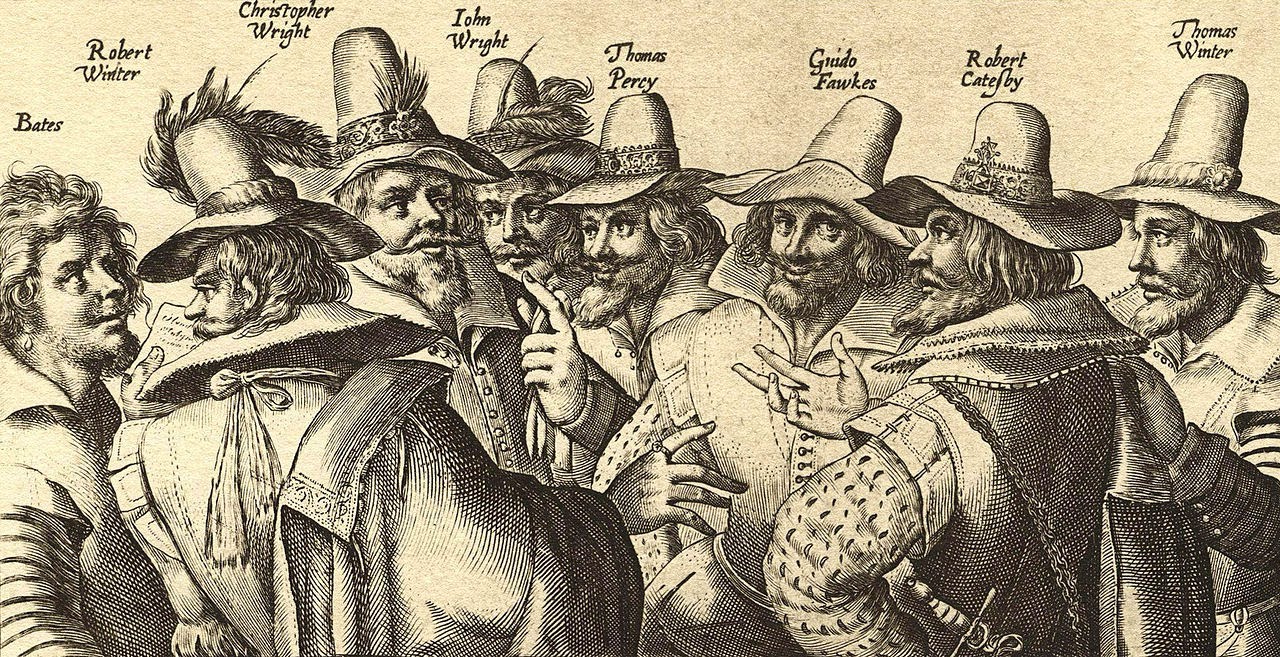
Guy Fawkes Day, also known as Bonfire Day, is a curious holiday.  It commemorates the failure on 5 November 1605 of the Gunpowder Plot, a scheme by a group of Catholics to blow up parliament and the Protestant King James I.  The plotters were betrayed, the barrels of gunpowder under the House of Lords were discovered in time, and the king's life was spared.

Members of the Gunpowder Plot
I find this a curious occasion to commemorate because it conforms neither to the major trend in holidays, nor to the primary exception.  Most holidays celebrate glorious triumphs such as victories in battle (e.g. Lepanto Day / Feast of the Holy Rosary), political successes (usually independence), or momentous spiritual events (e.g. the Incarnation or the Resurrection).  Some holidays, such as Thanksgiving, do not celebrate a particular triumph, but point to successes generally.  Apart from this major trend of celebrating victory, there is an exceptional category of holidays, which recall tragic failures, either gloriously defiant (e.g. the Alamo or the July 20 Conspiracy), or horrors from which we have, broadly speaking, taken some meaning or learned some lesson (e.g. Good Friday, September 11th, or Memorial Day).

But why do the English celebrate Guy Fawkes Day?  One might say it has become little more than an excuse for fireworks and bonfires, and this is probably true, but it only pushes the question to one step remove: why this day, and not some other?  The failure of the Gunpowder Plot was as much the fault of bumbling plotters as it was as success for the Crown and its supporters.  More to the point, the Plot was defeated not in honest battle or by national effort, but by shadowy intrigue.  Hardly the stuff of most victories.

Guy Fawkes Day, Lewes, England, 2011
Sadly, the real reason Guy Fawkes Day may have caught on in England is that it offered a chance to spite Catholics.  Indeed, the centerpieces of Guy Fawkes celebrations has traditionally been the burning in effigy of Mr. Fawkes and the pope.  Although other figures are often substituted today, this makes the holiday more than a tad bit awkward for Catholics.

But I have come to see the need for a third kind of holiday, the commemoration which does not yet possess resolution.  Perhaps my recent excursions into the historical books of the Old Testament have pushed me in this direction, for they are mostly filled with rebellions, defeats, and exile, epitomized by  Psalm 137: "By the waters of Babylon, / there we sat down and wept, / when we remembered Zion. / On the willows there we hung up our lyres. / For there our captors / required of us songs, / and our tormentors, mirth, saying, / 'Sing us one of the songs of Zion!' / How shall we sing the Lord’s song / in a foreign land?"  We have a small appetite for commemorating such events when they are recent, though memory quickly fades.  But history is replete with such calamities.  The burden of history, though it need not be overwhelming, certainly rests heavy on us, if only we open our eyes to see it.

For me, Guy Fawkes Day commemorates the difficulty of living in the world but not of it.  It commemorates the confusion that results when trying to square the demands of eternal faith with the demands of temporal politics.  It commemorates well-intentioned devotion gone awry.  It commemorates the reality that my co-coreligionists have undertaken actions I cannot always explain or justify.  It commemorates divided Christendom.  This is, or should be, a painful open wound.  Although there are lessons to be learned, I do not think we are yet at the point where we can say that we have learned them.  For now, we must simply recall.  We must bear the weight of history and trust that wisdom, some day, will follow.

Sunday, March 4, 2012

Seeing Through Political Propaganda


The other evening my wife and I watched Triumph of the Will, a film some of my history students will be watching.  This piece of Nazi propaganda depicts the 1934 Parteitag, an annual week-long festival for the National Socialists at Nuremberg.  There are a number of directions in which to take a discussion of this film.  I will point out to my students, for example, the chilling fact that the Night of the Long Knives had happened only two months before the rally, at which Hitler tried to persuade members of the SA and SS - the latter of which he used to murder the leaders of the former - that there were no disagreements within the Nazi Party.


But the film also reminded me of contemporary US politics.  No, I do not think Barack Obama is the next Hitler or that Mitt Romney is going to establish a totalitarian Mormon state.  Allow me to explain...

Triumph of the Will is, in many ways, a very appealing film.  There is some great cinematography, lots of pomp and spectacle, and thousands of nifty uniforms.  The film - and the party it idolizes - denounces class conflict and Communist revolution, instead calling for national unity and cooperation.  On a practical level, the Nazis highlight the jobs they have created and the roads they have built; on a higher plane, the Nazis utilize religious-style symbolism and Hitler calls upon a generation of young Germans to commit themselves in sacrifice for an ideal larger than themselves.

All of this, in the narrow terms I have described it, is quite good.  The problem is that the casual observer might not think further - indeed, the Nazis hoped they would not.  Because behind the pageantry and the soaring rhetoric are empty lies at best and utter wickedness at worst.

Why all the militant uniforms and talk of "victory" when Germany is not at war?  What is to become of those not deemed fully German?  Why is Hitler identified as the embodiment of both the nation and the party?  What qualities make him pre-eminently German, or who put him in charge?  And to what end is all this national effort and striving?  For what are Germans asked to sacrifice?  The more one considers the Nazis and their program, the less it makes sense.  In the end, it is nothing but the worship of Power for its own sake.

Some in Germany saw through the Nazis' propaganda, and thus Hitler was opposed by the likes of Blessed Clemens von Galen, Dietrich Bonhoeffer, Claus von Stauffenberg and the July 20 Conspirators, and a number of others.  Some of these men recognized the bankruptcy of the Nazi ideology early on; others only came around later.  Unfortunately most Germans lacked the intellectual insight or moral courage to perceive what was happening in their country and do something about it until it was too late.

Here in the US the stakes may not be quite so high, but the task is the same: we must see through the half-truths and the hollow rhetoric of those who would use our political support as pawns in their own games.  We must wage intellectual resistance against the political shams of our day; we must convert, ourselves first and then others.

Wednesday, July 20, 2011

The Men Who Opposed Hitler


Rebecca Haynes has recently produced a volume I am keen to read: In the Shadow of Hitler: Personalities of the Right in Central and Eastern Europe. As the title suggests, we often forget that Hitler was not the only politician of the Right in the interwar period. Some of the men Haynes considers were Nazi-sympathizers, but others were rivals or even bitter enemies of the National Socialists.

Today is the anniversary of the July 20 Conspiracy (about which I have written before). The conspiracy was an attempt to kill Hitler in 1944 and remove the Nazis from power. Its center of gravity lay in the Germany army, but extended to other segments of German government and society as well. By and large, these were men of the Right, men who believed in tradition and in German greatness. They opposed Communism and had no desire to see anything like a Soviet state established in the Fatherland. Some of them were anti-Semitic; many were not.

Today I'd like to briefly mention two men who opposed the Nazis, and did so from the right wing of the political spectrum. Neither was a among the most important members of the plot against Hitler, nor is either one a well-known figure, even among history buffs. But perhaps that makes them all the more typical (if we can use the term for such extraordinary men) of those who opposed the Nazis. The first is Friedrich Gustav Jaeger. Born in Württemberg in 1895, his father was a doctor. With the outbreak of World War I he quickly completed his secondary studies (with honors) and joined the German army, seeing service in both Flanders and Italy, and being decorated numerous times. After the war he studied agriculture and joined the National Socialist German Workers Party - the Nazis.

But then an interesting thing happened. Although Jaeger was a member of the Freikorps Oberland and later re-joined the army in 1934, he refused to participate in the Kapp Putsch and left the Nazi Party, becoming a fierce critic before World War II.

During the war Jaeger fought in Poland, France and Russia, receiving Germany's highest military honor. All the while, however, he was making contact with anti-Nazi elements of the German army. It was only with reluctance, however, that he agreed to the plan to try to assassinate Hitler: Jaeger's Christian faith caused him to prefer a trial before a proper court.

On the day of the attempted assassination, Jaeger had a variety of tasks, commanding reserve troops, arresting key Nazis and seizing a radio station. All this fell apart as the conspiracy was discovered, and Jaeger was eventually executed for his role on 21 August.

Ernst Rüdiger Starhemberg was born in Eferding, Austria in 1899. A prince of the Austro-Hungarian Empire, he served in the army during World War I, seeing action in Italy. Like Jaeger, he joined the Freikorps Oberland. Though the Austrian monarchy was abolished at the end of the war, he was keen to enter Austrian politics, joining the local branch of the Heimatschutz (an organization dedicated to protecting Austria's borders, but also its culture). He was intrigued by both Mussolini and Hitler, but gave up on the Nazis after the failed Beer Hall Putsch.

Starhemberg briefly served as Austrian Interior Minister in 1930 and became Deputy Leader of the conservative Christian Social Party in 1932. He then became Vice Chancellor in the right-wing government of Engelbert Dollfuß. Say what you will against Dollfuß - and there is probably much that can be said - he was no Nazi, as evidenced by the fact that they assassinated him in a failed bid to seize Austria. Starhemberg briefly served as acting Chancellor until a new government could be formed.

When the Nazis finally succeeded in annexing Austria, members of the Heimatschutz and various political parties with which Starhemberg had been associated were sent to concentration camps. He fled to Switzerland and eventually fought with the British and Free French air forces. Starhemberg was not a member of the July 20 Conspiracy. He abandoned the war effort when the Soviets joined the Allied side - what was the point of defeating Nazism if it were only followed by Soviet domination? - and moved to Argentina, staying until the year of Juan Peron's coup, and then returning to Austria.

Were these men heroes? The case for Jaeger is probably stronger than for Starhemberg. Both men certainly have associations that cause some raised eyebrows. But if they were not unqualified heroes, they were not villains either. They were men trying to make the best of difficult situations, men subject to all the human weaknesses. But in extraordinary circumstances, these men and other conservatives like them not only resisted the allure of Nazism, but opposed it. That is worth remembering.

Monday, July 20, 2009

Remembering the July 20 Plot - Again


Two years ago I wrote a post about the July 20 plot. This year, commemorating those who attempted to overthrow Hitler in 1944 is even more important to me.

This past semester, as part of my duties as a teaching assistant at Texas A&M, I led discussions on John Weiss' The Ideology of Death: Why the Holocaust Happened in Germany. Weiss' argument is easily caricatured: conservatives, traditionalists, big business and Christianity (in particular Catholicism) were responsible for the Holocaust. Only progressive, atheistic (or at least irreligious and relativistic) socialists are free of blame in Weiss' account.

The problems with The Ideology of Death are legion, too many to mention here. I shall concern myself with only one: Weiss all but ignores Colonel Claus von Stauffenberg (pictured left) and the July 20 conspirators. Why? Because Stauffenberg represents everything Weiss abhors: a Catholic, an aristocrat, a nationalist and a military officer.

Weiss dismisses the July 20 plotters as johnny-come-latelys. The socialists, he says, had been opposing Hitler from day one, whereas the army only turned against Hitler when it was apparent that defeat was in store. Besides the fact that authors such as Allen Dulles have shown that the army had grave misgivings about Hitler and his band of unprofessional thugs even before the war began, Weiss overlooks a key point: the socialists never came close to toppling Hitler. The July 20 conspirators did.

As if to add insult to injury, Weiss claims that Stauffenberg has been shunned by a nation of proto-fascist Nazi sympathizers in the modern Federal Republic of Germany. His case is weak, at best. Stauffenberg's son Berthold became a general in the post-war German army; another son, Franz-Ludwig, became an elected member of both the German and European parliaments. The members of Germany's elite Wachbataillon take their oath of service on July 20, at the Bendlerblock, where the July 20 conspirators met and were later executed. The street on which it sits has been renamed Stauffenbergstraße and the building now houses the Memorial to the German Resistance.

The modern German army, created in 1955, is keen to sever any connections with its Nazi predecessors. Thus, in addition to post-1955 innovations, there are only two legitimate sources of tradition in the Germany army. One source is the military reformers of the 19th century, men like Scharnhorst, Gneisenau, and Clausewitz. The other source are the lives and heroic deaths of the July 20 conspirators.

Stauffenberg and his coconspirators were not the only people within Germany to oppose Hitler; brave men and women such as Dietrich Bonhoeffer and the White Rose movement did likewise. We would do well to reflect on their sacrifices and defend their legacy against the likes of John Weiss.