Showing posts with label Battle of Lepanto. Show all posts

Wednesday, November 5, 2014

What Guy Fawkes Day Means to Me

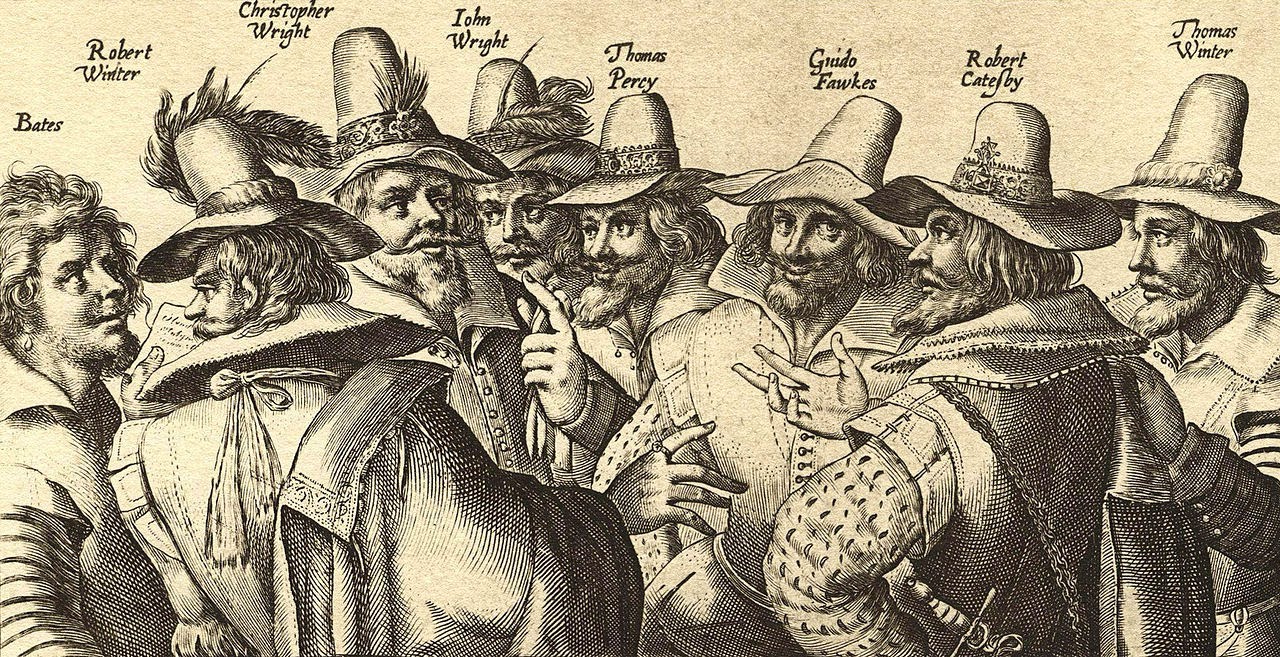
Guy Fawkes Day, also known as Bonfire Day, is a curious holiday.  It commemorates the failure on 5 November 1605 of the Gunpowder Plot, a scheme by a group of Catholics to blow up parliament and the Protestant King James I.  The plotters were betrayed, the barrels of gunpowder under the House of Lords were discovered in time, and the king's life was spared.

Members of the Gunpowder Plot
I find this a curious occasion to commemorate because it conforms neither to the major trend in holidays, nor to the primary exception.  Most holidays celebrate glorious triumphs such as victories in battle (e.g. Lepanto Day / Feast of the Holy Rosary), political successes (usually independence), or momentous spiritual events (e.g. the Incarnation or the Resurrection).  Some holidays, such as Thanksgiving, do not celebrate a particular triumph, but point to successes generally.  Apart from this major trend of celebrating victory, there is an exceptional category of holidays, which recall tragic failures, either gloriously defiant (e.g. the Alamo or the July 20 Conspiracy), or horrors from which we have, broadly speaking, taken some meaning or learned some lesson (e.g. Good Friday, September 11th, or Memorial Day).

But why do the English celebrate Guy Fawkes Day?  One might say it has become little more than an excuse for fireworks and bonfires, and this is probably true, but it only pushes the question to one step remove: why this day, and not some other?  The failure of the Gunpowder Plot was as much the fault of bumbling plotters as it was as success for the Crown and its supporters.  More to the point, the Plot was defeated not in honest battle or by national effort, but by shadowy intrigue.  Hardly the stuff of most victories.

Guy Fawkes Day, Lewes, England, 2011
Sadly, the real reason Guy Fawkes Day may have caught on in England is that it offered a chance to spite Catholics.  Indeed, the centerpieces of Guy Fawkes celebrations has traditionally been the burning in effigy of Mr. Fawkes and the pope.  Although other figures are often substituted today, this makes the holiday more than a tad bit awkward for Catholics.

But I have come to see the need for a third kind of holiday, the commemoration which does not yet possess resolution.  Perhaps my recent excursions into the historical books of the Old Testament have pushed me in this direction, for they are mostly filled with rebellions, defeats, and exile, epitomized by  Psalm 137: "By the waters of Babylon, / there we sat down and wept, / when we remembered Zion. / On the willows there we hung up our lyres. / For there our captors / required of us songs, / and our tormentors, mirth, saying, / 'Sing us one of the songs of Zion!' / How shall we sing the Lord’s song / in a foreign land?"  We have a small appetite for commemorating such events when they are recent, though memory quickly fades.  But history is replete with such calamities.  The burden of history, though it need not be overwhelming, certainly rests heavy on us, if only we open our eyes to see it.

For me, Guy Fawkes Day commemorates the difficulty of living in the world but not of it.  It commemorates the confusion that results when trying to square the demands of eternal faith with the demands of temporal politics.  It commemorates well-intentioned devotion gone awry.  It commemorates the reality that my co-coreligionists have undertaken actions I cannot always explain or justify.  It commemorates divided Christendom.  This is, or should be, a painful open wound.  Although there are lessons to be learned, I do not think we are yet at the point where we can say that we have learned them.  For now, we must simply recall.  We must bear the weight of history and trust that wisdom, some day, will follow.

Thursday, October 7, 2010

Two Anniversaries


On this day in 1571 the combined Christian forces of Spain, Venice, Genoa, Savoy, the Holy See and the Knights of Malta defeated the Ottoman Turkish fleet at Lepanto. The victory was attributed to the intercession of the Blessed Virgin Mary, to whom the Christian sailors had appealed by praying the rosary. Pope Pius V declared the day the Feast of Our Lady of Victory (later changed to Our Lady of the Rosary).

This feast of interest to me for two reasons. First, Our Lady of the Rosary is the patroness of our parish here in College Station, St. Mary's. Second, when the University of Dallas was founded by the Sisters of St. Mary of Namur, the junior college they ran in Ft. Worth - Our Lady of Victory College - was rolled into the new school. (Incidentally, I think Madonna Hall should be renamed Our Lady of Victory Hall, in honor of this history.)

Today is also the ninth anniversary of the US invasion of Afghanistan. Since that October day in 2001, the Taliban has been toppled from power, but not defeated. Over 1,200 Americans have been killed, along with another 800 or so coalition forces and more than 6,000 members of the Afghan security forces. Countless civilians have lost their lives.


US Special Forces riding with the Northern Alliance early in the conflict. Photo courtesy of of The Virtuous Republic.