Observant readers will notice that there have been a lot of liturgical commemorations here at the Guild Review, from the season of Advent to the particular holidays of the Annunciation (aka Lady Day) and Christmas to the feasts of Ambrose, Cecilia, Clare (and Clare again), Francis, Louis and Zelie, Michael (aka Michaelmas), Patrick, and Thomas More. Why is that, you ask?
The simple answer is that my life has been busy and it is much easier to post a prayer and a picture than to write a semi-coherent argument about a topic.
But the increased focus on the liturgical calendar also reflects developments in my life outside the blog. This may be a function of age. When I was younger I had considerable time to devote toward the pursuit of the Good, the True, and the Beautiful. I read, widely; I discussed ideas with friends; I turned over arguments in my head and wrote many of them down, some published here. But with the advent of middle age - a family, a mortgage, a 9-to-5 job - I find that much more of my time and energy is spoken for.
But it is here that the liturgical calendar reveals its genius. Built into the very rhythms of the liturgical year are all the great modes of the spiritual life: expectation, adoration, prayer, fasting, alms-giving, sorrow, triumph, and teaching. Below, so to speak, the great movements of the seasons there are the individual feast days, celebrating key moments in the earthly life of Jesus as well as the lives of disciples who sought to imitate him. These saints are as diverse a collection as one could imagine: men and women, rich and poor, priests, religious, spouses, scholars, evangelists, hermits, writers and artists, farmers and craftsmen, from every continent and every century from the Resurrection to the present. Even a passing mention of a handful of them becomes, over the course of a year, a veritable education in Christian living.
Thus, our family has been trying to notice more of the liturgical celebrations, as well as the Quarter and Cross-Quarter Days, great medieval markers of the year. We have done so with small observations: special desserts or crafts with the kids, a prayer for a saint's feast stuck to the bathroom mirror, a special song or story after supper. If your family is interested in doing likewise, resources abound; you might start with Carrots for Michaelmas, one of the many blogs dedicated to living the liturgical year.
In an increasingly secular age which so rarely has the time to pause and think about much of anything, the liturgical calendar invites us to align the rhythms of our daily lives with the heavenly choirs.
Showing posts with label holidays. Show all posts
Showing posts with label holidays. Show all posts
Tuesday, December 19, 2017

Friday, September 29, 2017
Happy Michaelmas!

Everlasting God,
You wonderfully ordered
the ministries of angels and mortals,
and sent the archangel Michael,
bearer of the banner of heaven,
to defend us against
the malice of Satan’s pride.
Do not forsake us in the last struggle with evil,
but by the aid of Your holy angels
bring us to eternal life,
through Christ our Lord. Amen.
How is your family planning to celebrate? There are a wealth of traditional foods for the celebration of the Archangel Michael. As this post explains, carrots, goose, special bread (St. Michael's Bannock) and blackberries are all on the traditional menu, for various reasons. Or waffles are, apparently, traditional in France; this website has a recipe and additional info. Other edible ideas I've seen include angel-shaped sugar cookies or really anything autumnal, since Michaelmas - almost exactly midway between Midsummer (St. John's Day) and Christmas - is the traditional approximation of the equinox and thus the beginning of autumn. If you're looking for decoration, aster flowers are also known as Michaelmas Daisies, because in many places they bloom around the feast.
Friday, March 24, 2017
Finding Joy Amidst the Sorrow - A Lady Day Reflection

The Annunciation, by Matthias Stom
In some ways this odd juxtaposition is simply the result of calendar constraints. If the Annunciation is to be celebrated the biologically proper nine months before Christmas (there, I told you), it's got to be in Lent. But I think we can also discern a deeper meaning to this scheduling coincidence. While Lent is traditionally associated with the Sorrowful Mysteries of the rosary, the Annunciation is the first of the Joyful Mysteries. And yet, if you give some thought to these so-called "Joyful" Mysteries, you see that their circumstances are rather ambiguous, possibly rather unhappy.
At the Annunciation, Mary - an unmarried young woman - is told that she will bear a child. At best, her neighbors and friends will presume she and her fiancé lack the continence to abstain from intimacy until marriage; it is quite possible they will assume far worse things about her character or that she will be exposed to the life-threatening provisions of the Jewish law regarding fornicators.
Mary, the single expectant mother, then travels "in haste" from the town of Nazareth to visit her kinswoman in Judah, to the south. Is she fleeing from Joseph? From her neighbors? Perhaps she simply travels to assist Elizabeth at the end of her own pregnancy. But no matter how noble Mary's actual intentions may be, they probably do little to quell the gossip. And then there is the matter of traveling - which, in Mary's day meant walking - probably by herself, for several days between Nazareth and Judah, while probably experiencing the morning sickness of the first trimester. Having arrived at the home of Elizabeth and Zechariah, Mary experiences the joy of hearing Elizabeth's inspired words of praise, but also has to deal with the difficulty that Zachariah has been struck mute, no doubt complicating chores and plans for the new baby's arrival.
At Christmas, as Mary's due date approached, she and Joseph - yet still unmarried - are forced to travel to Bethlehem because the Roman occupiers want to conduct a census. Oh joy. There in Bethlehem she gives birth to a son in a cave that's serving as a barn, because no one will offer them even a simple place to stay. Not exactly an optimal delivery experience.
While still in the Greater Jerusalem area - Bethlehem is not far away - Mary and Joseph bring the infant Jesus to the temple to present Him to the Lord. There the prophet Simeon tells Mary that a sword will pierce her heart. A short while later, Joseph is told in a dream by an angel that King Herod is trying to kill Jesus - and will indeed kill many innocent children in pursuit of the messiah. So the whole family, with only whatever possessions they happen to have with them, travel to Egypt, to live in exile for an indefinite length of time.
Finally, having returned to Nazareth after the death of Herod, Mary and Joseph might have thought they could settle into a quiet life. Then they lose track of Jesus while returning from a pilgrimage to Jerusalem. Is this the thanks they get for trying to fulfil the Law and observe the pilgrimage festivals? For three days they search about, doubtless with great anxiety.
These are the Joyful Mysteries: an unplanned pregnancy, gossip, foreign occupation, inhospitality, exile, heartbreak, and anxiety. If this is joy, I don't want to hear about sorrow!
Mary and Joseph were not naïve or oblivious. They recognized and experienced all these hurts and challenges. But the Joyful Mysteries are joyful because the Holy Family recognized much larger forces at work, the grace of the Incarnate God filling their lives.
Lady Day, the celebration of the Annunciation, is not simply a break from Lent, a moment where we can ignore our penance and the reality of suffering. Rather, Lady Day is a clarion call to see the world and all of life with the eyes of faith, by which we will perceive that God stands ever at hand, ready to transform our sorrows into joy, if only we will say with Mary: "May it be done to me according to your word."
Wednesday, November 5, 2014
What Guy Fawkes Day Means to Me
Guy Fawkes Day, also known as Bonfire Day, is a curious holiday. It commemorates the failure on 5 November 1605 of the Gunpowder Plot, a scheme by a group of Catholics to blow up parliament and the Protestant King James I. The plotters were betrayed, the barrels of gunpowder under the House of Lords were discovered in time, and the king's life was spared.
I find this a curious occasion to commemorate because it conforms neither to the major trend in holidays, nor to the primary exception. Most holidays celebrate glorious triumphs such as victories in battle (e.g. Lepanto Day / Feast of the Holy Rosary), political successes (usually independence), or momentous spiritual events (e.g. the Incarnation or the Resurrection). Some holidays, such as Thanksgiving, do not celebrate a particular triumph, but point to successes generally. Apart from this major trend of celebrating victory, there is an exceptional category of holidays, which recall tragic failures, either gloriously defiant (e.g. the Alamo or the July 20 Conspiracy), or horrors from which we have, broadly speaking, taken some meaning or learned some lesson (e.g. Good Friday, September 11th, or Memorial Day).
But why do the English celebrate Guy Fawkes Day? One might say it has become little more than an excuse for fireworks and bonfires, and this is probably true, but it only pushes the question to one step remove: why this day, and not some other? The failure of the Gunpowder Plot was as much the fault of bumbling plotters as it was as success for the Crown and its supporters. More to the point, the Plot was defeated not in honest battle or by national effort, but by shadowy intrigue. Hardly the stuff of most victories.
Sadly, the real reason Guy Fawkes Day may have caught on in England is that it offered a chance to spite Catholics. Indeed, the centerpieces of Guy Fawkes celebrations has traditionally been the burning in effigy of Mr. Fawkes and the pope. Although other figures are often substituted today, this makes the holiday more than a tad bit awkward for Catholics.
But I have come to see the need for a third kind of holiday, the commemoration which does not yet possess resolution. Perhaps my recent excursions into the historical books of the Old Testament have pushed me in this direction, for they are mostly filled with rebellions, defeats, and exile, epitomized by Psalm 137: "By the waters of Babylon, / there we sat down and wept, / when we remembered Zion. / On the willows there we hung up our lyres. / For there our captors / required of us songs, / and our tormentors, mirth, saying, / 'Sing us one of the songs of Zion!' / How shall we sing the Lord’s song / in a foreign land?" We have a small appetite for commemorating such events when they are recent, though memory quickly fades. But history is replete with such calamities. The burden of history, though it need not be overwhelming, certainly rests heavy on us, if only we open our eyes to see it.
For me, Guy Fawkes Day commemorates the difficulty of living in the world but not of it. It commemorates the confusion that results when trying to square the demands of eternal faith with the demands of temporal politics. It commemorates well-intentioned devotion gone awry. It commemorates the reality that my co-coreligionists have undertaken actions I cannot always explain or justify. It commemorates divided Christendom. This is, or should be, a painful open wound. Although there are lessons to be learned, I do not think we are yet at the point where we can say that we have learned them. For now, we must simply recall. We must bear the weight of history and trust that wisdom, some day, will follow.
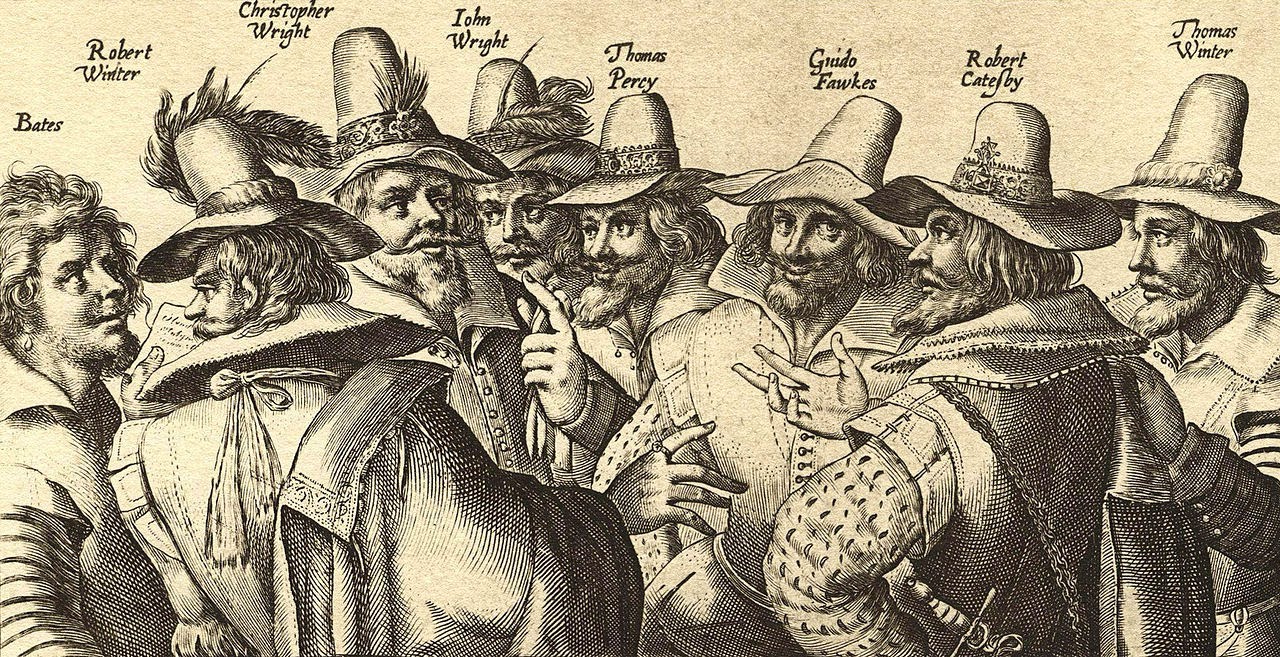 |
| Members of the Gunpowder Plot |
But why do the English celebrate Guy Fawkes Day? One might say it has become little more than an excuse for fireworks and bonfires, and this is probably true, but it only pushes the question to one step remove: why this day, and not some other? The failure of the Gunpowder Plot was as much the fault of bumbling plotters as it was as success for the Crown and its supporters. More to the point, the Plot was defeated not in honest battle or by national effort, but by shadowy intrigue. Hardly the stuff of most victories.
 |
| Guy Fawkes Day, Lewes, England, 2011 |
But I have come to see the need for a third kind of holiday, the commemoration which does not yet possess resolution. Perhaps my recent excursions into the historical books of the Old Testament have pushed me in this direction, for they are mostly filled with rebellions, defeats, and exile, epitomized by Psalm 137: "By the waters of Babylon, / there we sat down and wept, / when we remembered Zion. / On the willows there we hung up our lyres. / For there our captors / required of us songs, / and our tormentors, mirth, saying, / 'Sing us one of the songs of Zion!' / How shall we sing the Lord’s song / in a foreign land?" We have a small appetite for commemorating such events when they are recent, though memory quickly fades. But history is replete with such calamities. The burden of history, though it need not be overwhelming, certainly rests heavy on us, if only we open our eyes to see it.
For me, Guy Fawkes Day commemorates the difficulty of living in the world but not of it. It commemorates the confusion that results when trying to square the demands of eternal faith with the demands of temporal politics. It commemorates well-intentioned devotion gone awry. It commemorates the reality that my co-coreligionists have undertaken actions I cannot always explain or justify. It commemorates divided Christendom. This is, or should be, a painful open wound. Although there are lessons to be learned, I do not think we are yet at the point where we can say that we have learned them. For now, we must simply recall. We must bear the weight of history and trust that wisdom, some day, will follow.
Saturday, October 29, 2011
The Festal Fortnight!

These holidays are an odd mix of pagan and Christian, historical and political. Some people might say the mix is coincidental, eclectic or even dangerous. In my mind, two things make these holidays cohere.
First, the pagan can be subsumed into the Christian. This is not simply religious or cultural plagiarism. Rather, in Christianity, grace builds on nature. And it is quite natural to reflect on the reality of death in early November, as the world around us dies. Likewise, it is natural to reflect on the reality of spirits (both good and bad) among us, as the shadows lengthen and an air of mystery begins to settle. I am quite happy to give Christian answers to pagan questions, so to speak.
Secondly, I believe history is divinely ordained (if not always in ways we can perceive). Thus, to say that several holidays "coincidentally" fall near one another is simply to say that the hand of God has brought them together, rather than the hand of man. I lose no sleep on this point either.
31 October: All Hallow's Eve/Samhain.Halloween is no doubt the best known of this string of holidays. Scholars argue that the Christian feast of All Saints Day has its roots in - or at least owes its timing to - the earlier Celtic festival of Samhain, which marks the end of the harvest. This holiday has become woefully commercialized, but when you place it in its larger autumnal context, I think some of its richness begins to return.
1 November: All Saint's Day/Calan Gaeaf. Calan Gaef is the first day of winter in Wales, which seems a fitting day to think about those who have died (and are now in glory). However, the holiday has a rather dark hue - involving hags, evil spirits in the form of a black sow and a headless woman, and predictions of death - so we'll be celebrating this day along fairly traditional Christian lines, perhaps with mass and the Liturgy of the Hours.
2 November: All Soul's Day. Time permitting, my wife and I will visit the local cemetery to pray for the dead. I have done this for several of the past few years, and I can say that it is a slightly odd experience, simply strolling among graves of people you do not know, who are of no particular significance to you. It brings home the reality of Death as a general phenomenon, apart from the particular ways it affects us. Praying for strangers can also remind us that we too may be the beneficiaries of strangers' prayers. We should probably return the favor.
5 November: Bonfire Day. Guy Fawkes and Bonfire Day are the motif running through V for Vendetta, the comic book made into a movie (which my wife and I first watched last year). Admittedly, this has traditionally been an anti-papist day, but I'm sure there's some way we can baptize it.
6 November: Gustav Adolfsdagen. In honor of the great 17th century king and general, this is a national holiday in Sweden, a country from which some of my ancestors came. (See the recurring connection with the dead!) I have not celebrated this holiday before, but I am intrigued by its pastry, Gustav Adolfsbakelse, for which, alas, I have not yet found a recipe.

11 November: Armistice Day/Veteran's Day/Feast of St. Martin. It is fitting that the First World War ended on the feast of one of the patrons of soldiers. Some might say that wars should begin on such days, but I think not. As St. Bernard of Clairvaux explains, "The true Israelite is a man of peace, even when he goes forth to battle." St. Martin's Day is traditionally marked by carrying candles and lanterns, which seems a fitting seasonal defense against the creeping darkness, and also a fitting memorialization of the millions of war dead. That toys are traditionally given to children on St. Martin's Day in some Germanic countries might seem at odds with the somber remembrance of the war's end and the shortening days of the year. Not that we'll be giving toys in our home, but I think this too is fitting: such toys are a reminder that the harvest has been gathered and (God willing) we are abundantly stocked for the months ahead. Giving toys to children is also a useful reminder of the healing and rebirth that must follow a war: if only sorrow remains, the fallen have died in vain.
Some places serve goose on St. Martin's Day, on account of how the saint hid, while trying to avoid the episcopate, but had his position given away by geese. A goose might be a bit much for us, but I am intrigued by this recipe for Martinshörnchen, the traditional hoof-shaped pastries. Damassine is the traditional St. Martin's Day liqueur in Switzerland. In the US, ravioli was once a kind of Veteran's Day tradition, since President Wilson fed it to 2,000 returning soldiers who dined at the White House. (Though, frankly, I've never heard of this custom, so I'm not so sure how widespread it ever became.)
And if you've not already used up all the firewood on the 5th, bonfires are traditional on St. Martin's Eve.
13 November [this year]: Remembrance Sunday. Observed on the Sunday nearest 11 November, this is a kind of second Armistice Day, but with the particular purpose of praying for the fallen. It may be sheer coincidence, but it seems fitting that we pray for the souls lost in the 20th century's first great bloodbath mere days after All Soul's Day.

Today's image of the Vigil of All Saints at the Dominican House of Studies in Washington comes via the Dominican Province of St. Joseph.
Subscribe to:
Posts (Atom)