Here in the Linderman household, it is almost time for the Festal Fortnight. That is what I have tentatively decided to call this string of autumnal holidays we have coming up.
These holidays are an odd mix of pagan and Christian, historical and political. Some people might say the mix is coincidental, eclectic or even dangerous. In my mind, two things make these holidays cohere.
First, the pagan can be subsumed into the Christian. This is not simply religious or cultural plagiarism. Rather, in Christianity, grace builds on nature. And it is quite natural to reflect on the reality of death in early November, as the world around us dies. Likewise, it is natural to reflect on the reality of spirits (both good and bad) among us, as the shadows lengthen and an air of mystery begins to settle. I am quite happy to give Christian answers to pagan questions, so to speak.
Secondly, I believe history is divinely ordained (if not always in ways we can perceive). Thus, to say that several holidays "coincidentally" fall near one another is simply to say that the hand of God has brought them together, rather than the hand of man. I lose no sleep on this point either.
31 October: All Hallow's Eve/Samhain.Halloween is no doubt the best known of this string of holidays. Scholars argue that the Christian feast of All Saints Day has its roots in - or at least owes its timing to - the earlier Celtic festival of Samhain, which marks the end of the harvest. This holiday has become woefully commercialized, but when you place it in its larger autumnal context, I think some of its richness begins to return.
1 November: All Saint's Day/
Calan Gaeaf. Calan Gaef is the first day of winter in Wales, which seems a fitting day to think about those who have died (and are now in glory). However, the holiday has a rather dark hue - involving hags, evil spirits in the form of a black sow and a headless woman, and predictions of death - so we'll be celebrating this day along fairly traditional Christian lines, perhaps with mass and the Liturgy of the Hours.
2 November: All Soul's Day. Time permitting, my wife and I will visit the local cemetery to pray for the dead. I have done this for several of the past few years, and I can say that it is a slightly odd experience, simply strolling among graves of people you do not know, who are of no particular significance to you. It brings home the reality of Death as a general phenomenon, apart from the particular ways it affects us. Praying for strangers can also remind us that we too may be the beneficiaries of strangers' prayers. We should probably return the favor.
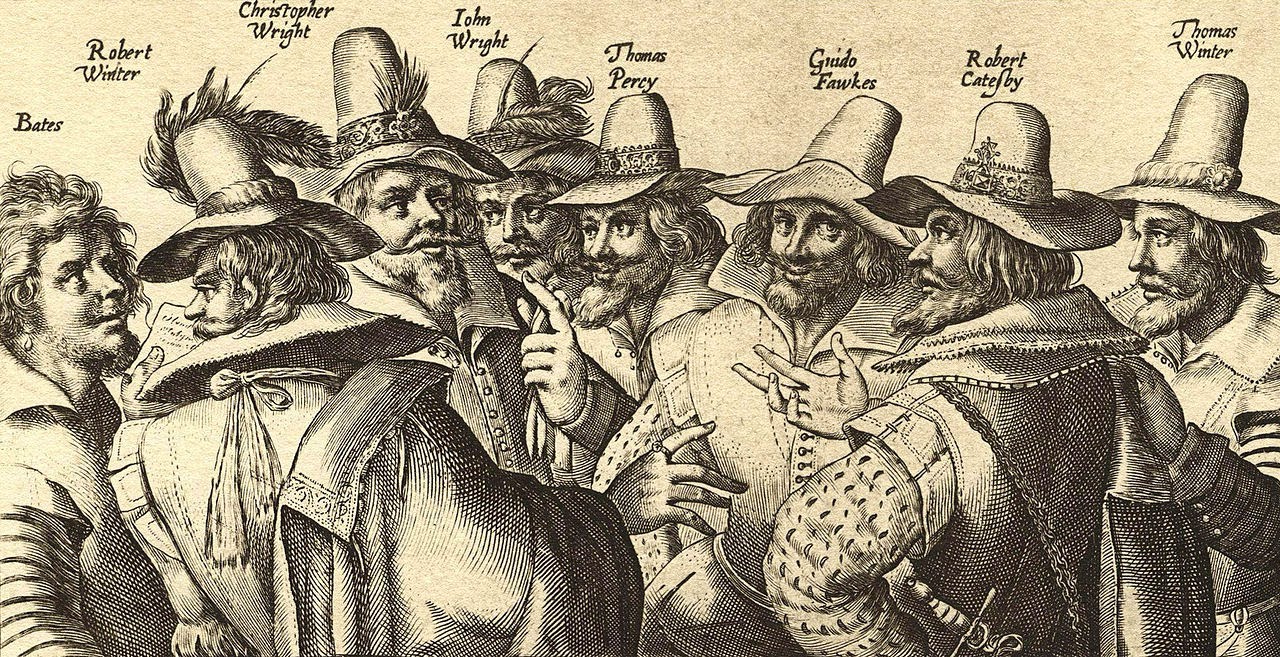
5 November: Bonfire Day. Guy Fawkes and Bonfire Day are the motif running through
V for Vendetta, the comic book made into a movie (which my wife and I first watched last year). Admittedly, this has traditionally been an anti-papist day, but I'm sure there's some way we can baptize it.
6 November: Gustav Adolfsdagen. In honor of the great 17th century
king and general, this is a national holiday in Sweden, a country from which some of my ancestors came. (See the recurring connection with the dead!) I have not celebrated this holiday before, but I am intrigued by its pastry,
Gustav Adolfsbakelse, for which, alas, I have not yet found a recipe.
11 November: Armistice Day/Veteran's Day/Feast of St. Martin. It is fitting that the First World War ended on the feast of one of the patrons of soldiers. Some might say that wars should
begin on such days, but I think not. As St. Bernard of Clairvaux
explains, "The true Israelite is a man of peace, even when he goes forth to battle." St. Martin's Day is traditionally marked by carrying candles and lanterns, which seems a fitting seasonal defense against the creeping darkness, and also a fitting memorialization of the millions of war dead. That toys are traditionally given to children on St. Martin's Day in some Germanic countries might seem at odds with the somber remembrance of the war's end and the shortening days of the year. Not that we'll be giving toys in our home, but I think this too is fitting: such toys are a reminder that the harvest has been gathered and (God willing) we are abundantly stocked for the months ahead. Giving toys to children is also a useful reminder of the healing and rebirth that must follow a war: if only sorrow remains, the fallen have died in vain.
Some places serve goose on St. Martin's Day, on account of how the saint hid, while trying to avoid the episcopate, but had his position given away by geese. A goose might be a bit much for us, but I am intrigued by this recipe for
Martinshörnchen, the traditional hoof-shaped pastries.
Damassine is the traditional St. Martin's Day liqueur in Switzerland. In the US, ravioli was once a kind of Veteran's Day tradition, since President Wilson fed it to 2,000 returning soldiers who dined at the White House. (Though, frankly, I've never heard of this custom, so I'm not so sure how widespread it ever became.)
And if you've not already used up all the firewood on the 5th, bonfires are traditional on St. Martin's Eve.
13 November [this year]: Remembrance Sunday. Observed on the Sunday nearest 11 November, this is a kind of second
Armistice Day, but with the particular purpose of praying for the fallen. It may be sheer coincidence, but it seems fitting that we pray for the souls lost in the 20th century's first great bloodbath mere days after All Soul's Day.
Today's image of the Vigil of All Saints at the Dominican House of Studies in Washington comes via the
Dominican Province of St. Joseph.