Showing posts with label history. Show all posts

Saturday, November 24, 2018

¡Viva Cristo Rey! - British Style

Tomorrow is the Solemnity of Christ the King, instituted by Pope Pius XI in 1925.  Coming on the final Sunday of the liturgical year, it is a reminder that, at the end of time, Christ will return to judge the living and the dead.  It's a nice segue into Advent, when we will reflect on both Jesus's first coming as a baby and His second coming in glory.

The feast also reminds us that Jesus Christ is sovereign over all things.  All people and nations, all rulers and governments are ultimately under His authority.

This solemnity was instituted partly in reaction to contemporary events in Mexico, where an anti-Catholic government had come to power in the Mexican Revolution.  When a new set of anti-Catholic laws were passed in 1926, Catholics - known as Cristeros - took up arms against the government, adopting as their battle cry the phrase, "¡Viva Cristo Rey!": Long live Christ the King.

Our family's favorite hymn, "Lo! He Comes with Clouds Descending," is one appropriate for Advent or for tomorrow's solemnity.  The text, which comes in a few variations, is by Charles Wesley:
Lo! He comes, with clouds descending,
once for our salvation slain;
thousand thousand saints attending
swell the triumph of His train.
Alleluia! Alleluia! Alleluia!
Christ the Lord returns to reign!
Ev'ry eye shall now behold Him,
robed in dreadful majesty;
those who set at naught and sold Him,
pierced, and nailed Him to the tree,
deeply wailing, deeply wailing, deeply wailing,
shall the true Messiah see. 
Those dear tokens of His passion
still His dazzling body bears;
cause of endless exultation
to His ransomed worshippers;
with what rapture, with what rapture, with what rapture
waze we on those glorious scars! 
Yea, amen! Let all adore Thee,
high on Thine eternal throne;
Savior, take the pow'r and glory,
claim the kingdom for Thine own:
Alleluia! Alleluia! Alleluia! Alleluia!
Thou shalt reign and thou alone.
Here it is sung by the choristers of Lichfield Cathedral in the North-West Midlands of England:


Wednesday, September 27, 2017

Teaching Medieval History: How Should We Do It Today?

In an age when controversies and commentary happen at the speed of Twitter, I do not profess to have kept up with all the twists and turns in the saga of Rachel Fulton Brown, a medievalist at the University of Chicago. But, so far as I can tell, the story went something like this: A couple years ago Prof. Brown wrote a blog post noting that medieval white men had done some good. In light of recent white supremacist shenanigans, another medievalist left a comment on this old blog post, essentially asking Prof. Brown what she was doing to set the record straight and fight racism. Prof. Brown took issue with this perceived politicization and the whole thing descended from there.

There are three questions (possibly more) at issue here: How do we teach medieval history? How do we interact as professional historians? And how should history be employed to political ends?

I am currently teaching medieval history to high school students (specifically, a British history survey; the first semester is medieval, the second modern). My basic approach is to point out some of the good things going on - we discuss literary achievements, religious life, and the role of women such as Etheldreda and Leoba - while also acknowledging the shortcomings in justice, knowledge, and material standards of living. So far as I can tell, Prof. Brown has taken a similar approach. She has not claimed that medieval Europe was a paradise, but neither is she willing to suggest - as some in academia do - that the thousand years of medieval history are one long record of unbroken oppression. Likewise, she has not claimed that European or Western civilization is, in every respect, superior to all other cultures of the world; but neither has she characterized Western civilization as inherently bad. One may quibble with some details, but her overall approach is very sound history; to deviate from it would be a shame.

In lashing out at her critics, Prof. Brown has not always used kind or professional language. For that, she deserves a stern talking to from her department head. But calling for her job is a bit much. Her opponents should know that you cannot publicly criticize someone without expecting them to respond, possibly disproportionately, possibly in an unprofessional manner. This is unfortunate but not the end of the world.

But the crux of the controversy seems to be the role of history in contemporary debates. Some people argue that there is an imperative duty for all academics to wield their professional tools in a partisan manner; their central task, the argument goes, is to fight injustice. The error here is not in presuming that academics can weigh in on current debates. Rather, the error is two-fold: presuming that academics must engage in such debates and failing to appreciate the deep long-term contributions of academia to the cause of justice, without mentioning contemporary issues. Teaching students how to reason; how to think deeply about culture, politics, and religion; teaching them to express themselves clearly in speech and in writing - these are profound contributions to the common life of our country. Indeed, I would argue that over emphasis on the latest subject of protest risks undermining the very important work of fostering these necessary habits of thought.

So far as I can tell, Prof. Brown shares the my understanding of the role of history. She has not, to my knowledge, insisted that academics avoid all discussion of current controversies or politics; rather, she simply asks that her non-participation in such crusades not be held against her while she is busy carrying out these other essential tasks of history. I hope, for everyone's sake, this tempest ends soon so that we can stop the comment wars and get back to more important work.

Friday, July 28, 2017

The Lost Cause: Old, New, and What To Do About It


I am not a Southerner, but I am something of a guest of the South. Although an Arizona native, I went to school in Texas (twice), married a gal from Mississippi, and settled in Virginia. Like many Americans, recent controversies surrounding Confederate monuments have spurred along my ongoing efforts to understand Southern heritage.

I appreciated Gregory S. Bucher's "Romanticism of the 'Lost Cause,'" published in First Things, for one particular insight it brought me: just because one racist raises a monument to another racist, that does not necessarily mean that racism was the motive for raising the monument. Without disputing that the Civil War was fundamentally about slavery - the declarations of secession were pretty explicit about that - one can recognize that the 19th century worldview was considerably different from most contemporary worldviews. Lost causes - not just The Lost Cause, but all of them - had a particular appeal to many, both within and outside the South, quite irrespective of the content of the cause. Seemingly fruitless suffering, most in need of justification, was conveniently - in the Romantic worldview - most noble.

History sometimes grants us insights into the motivations of actors, but those insights are rare gems. More often we know what was done, but not why. Doubtless, some erectors of Confederate monuments raised them with the explicit intention to further white supremacy and do so by casting a cloak of courage and liberty - and thus respectability - over the Southern rebellion. But I suspect that many monument erectors, whether they were racists or not, firmly believed themselves to be honoring courage, sacrifice, and freedom, even if their actions had the effect of entrenching white supremacy in the South and whitewashing the historical narrative.

History informs how we behave in the present, but it does not dictate our behavior. Discussions of history and present policy, though interrelated, are distinct issues. We may be cautious about passing historical judgements, while still being clear about what contemporary society should do. But even if, with the value of hindsight, we recognize certain monuments as racist and conclude that they must go, we can still be charitable, perhaps even generous, toward many who erected them and still value them today.

* * *

While listening to Gillian Welch - whose music, though beautiful, is consistently depressing - it occurred to me that swaths of contemporary America have embraced a new permutation of the Lost Cause myth, depicted in a variety of musical and other cultural representations. The patchwork of folk and country references which follow many strike some readers as eclectic; perhaps other selections could have been made, but I think these demonstrate the breadth of this general pattern.

The story goes something like this: America, or this corner of it, this was once an agrarian place. It was not prosperous, but homey and traditional: "We all picked the cotton but we never got rich," as Alabama sings. Or, in the words of the Carolina Chocolate Drops:
Runnin' with your cousins from yard to yard
Livin' was easy but the playin' was hard
Didn't have much, nothing comes for free
All you needed was your family.
In time, this agrarian world gave way to aspects of modern industrialization, things like coal mines and railroads. But many of its promises were unfulfilled and, after having broken the health of so many workers, this industrialization seems to have left them behind. Dan Zanes laments the railroad that never came:
Then up stepped a politician
He stopped her in her tracks
From what I understand
He turned her sent her back
The people down in Guysborough
Still waiting for a train
The dream they had for many years
Proved to be in vain.
Tom Russell describes the closing of a steel mill: "My wife stares out the window with a long and lonely stare / She says 'you kill yourself for 30 years but no one seems to care.'" 

The evils of industrialization are found in the traditional Lost Cause myth as well. Eric Foner explains, “The antebellum South was recalled as a benevolent, orderly society that pitted its noble values against the aggressive greed of northern industrial society.” In both narratives, industrialization is identified with outside forces; it is, at best, fickle, more likely deceptive and exploitative.

Yet for better or worse, industrialization came, and then largely went. So where does that leave us now? There's a strange mix of sorrow in the new Lost Cause at all that is lost and almost a celebration of the ills left behind. Gillian Welch sings:
A river of whiskey flows down in Dixie
Down along the Dixie Line
They pulled up the tracks now
I can't go back now
Can't hardly keep from cryin'.
Indeed, alcohol is a recurring theme, both in sorrow and in celebration. Charlie Daniels boasts:
People say I'm no good and crazy as a loon
'Cause I get stoned in the morning
And get drunk in the afternoon
Kinda like my old blue tick hound
I like to lay around in the shade
And I ain't got no money but I damn sure got it made.
Or, in a more elegiac form, Brad Paisley and Alison Krauss relate a tragic tale:
We watched him drink his pain away a little at a time
But he never could get drunk enough to get her off his mind
Until the night...
He put that bottle to his head and pulled the trigger
And finally drank away her memory
Life is short but this time it was bigger
Than the strength he had to get up off his knees.
Like the traditional Lost Cause, this new narrative admits to failure, but also accepts, even embraces it..

The musical threads of the new Lost Cause tapestry are certainly found in the old Confederate states, the traditional definition of the South. But they are also found across a wider geography, including much of the Rust Belt and Middle America. The areas where this new Lost Cause is found probably align well with parts of the country that voted for Donald Trump. And this should come as little surprise: according to this new mythology, much has indeed been lost, hence the need to make America great again. But amidst this narrative’s drunken post-industrial suffering, there is also a sense that greatness cannot be regained, at least not along the old lines. Thus America did not elect a senator or a general or even a Boy Scout, but, rather, a loud-mouthed, twice-divorced zillionaire with no record of public service. In the ruins of American society, you could say, this is the best we can hope for.

* * *

Southern writers reflect something of the new narrative as well. The characters described by William Faulkner, Flannery O'Connor, or Walker Percy are hardly winners. They are frequently insane and often vicious. If they have not had a stiff drink lately, they could probably use one. Suffering, these writers admit, is the way of our world.

Their writings share a certain quality of anti-modernism with both Lost Causes, the old and the new. Modern society, they implicitly argue, has not reached the deepest corners of the South or, if it has, it has failed to solve its ills. More likely, modernity has made those ills worse.

One might conclude from this sorry state of affairs that some kind of Southern revivalism is needed: if we reject the modern social, economic, and political arrangements imported from the North, if we go back to the old ways, all will be well. But I do not think this the approach that the likes of Percy and O'Connor would endorse.

Though these Catholic writers had a deep respect for tradition, they recognized that the flaws of the modern era run deep. Our common suffering is ultimately rooted not in modernity, however problematic it may be, but in man's fallen nature. We ought not celebrate our brokenness, but we must at least admit to it. Erecting monuments will not solve our problems. Hiding amidst the babble of modern psychology will ultimately leave us deeply unsatisfied, as Percy repeatedly underscores in Lost in the Cosmos. Rather, we must offer our pathetic situation, the husk of our individual selves and our broken society, to the one who has the power to save, Almighty God. Conversion has the power to accomplish what no amount of nostalgia or memorialization ever could. Lord, have mercy.

Wednesday, February 15, 2017

Beautiful Indian Summers - But to What End?

A little while ago my wife and I began watching Indian Summers, a show about the British Raj's annual move to Simla, in the foothills of the Himalaya, where it sheltered from Delhi's summer heat. The show is visually stunning, marked by the natural beauty of the landscape (actually shot in Malaysia) and the pomp of the Raj. For a historian of the British Empire, the draw is obvious. But we've been on an Indian Summers hiatus of late. By tacit agreement, we just started doing other things in the evening.

The show's characters, though interesting, may have missed a certain je ne sais quoi. The plot, though intriguing, was not quite compelling. But my disquiet about the show was something else. Something more fundamental.

Friedrich Nietzsche, in his Advantages and Disadvantages of History for Life, described three kinds of history. Monumental history glorifies the past; it holds up the heroes of yesteryear as models to be imitated. Critical history highlights all that was wrong in the past, and in so doing spurs us on to do better today. Antiquarian history is less dynamic: it describes the past as essentially the same as the present. It takes comfort in the great continuity of human society.

Viewed through this lens, Indian Summers is puzzling. It is not monumental. Although the splendor of the Raj is on display, the show clearly conveys that the Raj was oppressive, dishonest, and generally out of touch with the people it governed. And yet I would hesitate to describe the show as critical. The Indian nationalist movement - at least in the episodes we watched - comes off as morally justified, but not dramatically so, not enough to decisively turn our sympathies against the British characters. Given the enormity of the questions at stake, there is a surprising amount of moral ambivalence.

So Indian Summers must be antiquarian, right? Here we come to the crux of my complaint. At first glance, the show would not seem to fit the basic antiquarian mold: its power struggles, deceptions, and unbridled lust for power and the pleasures of the flesh bear little resemblance to my own life. Is this essentially the same as the present day?

Indian Summers is a mirror reflecting many of the worst qualities of 21st century America. The quest for power is taken as a given. Fornication and adultery are essentially no different from a good meal: if the cost is not unreasonable, well worth enjoying. Truth and justice, though not entirely banished, have become moral garnishes. For those who live in this version of modern society, Indian Summers conveys the message that the Raj looked much like the present. That which is enjoyed or feared, valued or despised today was held in similar regard in every age, was it not?

But for those of us who still inhabit those corners of contemporary society where desires are subordinated to duties, where power has value only in relation to the ends it accomplishes, where fidelity is not merely a burden to be carried but a virtue to be celebrated, Indian Summers is a depressing scene. That these shortcomings are not even recognized is more depressing still.

Thursday, January 26, 2017

Journey to Colonus: A Historical Novel and Much More

Franklin Debrot's debut novel, Journey to Colonus, though a work of historical fiction long in the making, is a work for the present day, with themes of racial conflict, political divisions, campus agitation, and Russian influence in America. That all this is discussed in a novel which is well crafted makes it a very worthy candidate for your 2017 reading list.

The story begins in 1969, on the campus of a fictional black college in North Carolina, at a time of considerable political maneuvering, with alliances and factions abounding. Our main character, Thomas Doswell, a college professor, stands oddly apart from all this, focusing instead on great works of literature and philosophy. Through his unfolding relationships with his teaching assistants, we learn not only about his approach to education and the vicissitudes of their personal lives, but first and foremost about Doswell's secretive and dynamic past, including involvement with the Communist International.

Journey to Colonus has a measured pace. It takes much of the novel for all the key pieces to get into place, but Debrot ensures that these parts are as compelling as the whole. There are a few moments where the jumping between decades is a bit disorienting, but I was overwhelmingly impressed by Debrot's ability to develop characters and weave together the disparate elements of their stories. (As someone who has toyed with writing fiction, I can tell you that it's harder than it looks, arguably far harder than writing non-fiction.)

Debrot's novel rests on solid historical ground. An extensive appendix points to many of the author's sources for historical context. (From my own reading in American history and the history of the Comintern, including this biography of one agent, Journey to Colonus gets both the broad dynamics and the particular details right.) Moreover, the novel overlaps heavily with Debrot's own biography: growing up in New York, among the West Indian community, and teaching at a black college in North Carolina in the 1960s. This is familiar territory for him.

Some might object to what they see as an overly conservative book. After all, Senator Joseph McCarthy's role in the Tydings Committee's investigation of Communists in the State Department, for example, comes off broadly positive. But accusations of partisanship would be a superficial misreading of Journey to Colonus. The novel acknowledges that McCarthy was right, or very nearly so, about matters of national importance, but it also recognizes some unsavory elements of his personal life and tactical mistakes in his pursuit of Soviet influence. More to the point, Debrot's profoundly humane novel shows that people's actions, both personal and political, arise from a wealth of diverse influences. Without excusing immorality, Journey to Colonus acknowledges that results often differ from intentions, that people are sometimes funneled by their pasts into certain paths, and that appearances are not always what they seem.

At its heart, this novel addresses a topic that has been of considerable interest to me in the last few years, a topic found from Shakespeare's plays to such recent television shows as The Crown and The Man in the High Castle, namely the intersection of the personal and political. National and international politics do not simply happen on their own: they are the products of individuals and their interactions, with all the quirks that entails. Likewise, politics does not simply exist in newspaper headlines, but has real implications for the lives of individuals. All of which makes the pursuit of wisdom and authentic relationships so important. Journey to Colonus is an enjoyable and enlightening guide along that path.

Friday, September 16, 2016

Happy Von Steuben Day!

Tomorrow is the birthday of Friedrich von Steuben, a German aristocrat and soldier who came to the infant United States to assist in the War of Independence.

Friedrich Wilhelm Ludolf Gerhard Augustin von Steuben was born in Magdeburg, Prussia in 1730. Young Friedrich's father fought on behalf of the Tsarina of Russia, and therefore the son spent several years there.  He was later educated by Jesuits and served on his first campaign with his father at the age of 14.  He rose through the ranks of the Royal Prussian Army and became aide-de-camp (personal assistant) to King Friedrich the Great.  In 1771 von Steuben was made a baron.  Having suffered from debt, military politics, and unproven accusations of illicit relations for more than a decade, he came to America in 1777 to offer his services.

Von Steuben was named inspector general of the young Continental Army and brought a professional's eye to sanitation, record-keeping, procurement, and military drill.  Initially lacking command of the English language, he wrote his orders in French and had them translated.  He was attached to the headquarters of George Washington and Nathanel Greene and commanded a division in the Yorktown campaign.  After the war he oversaw the founding of the Society of the Cincinnati and became an elder of the German Reformed Church.

Although German-Americans are the largest ethnic group in the country, Von Steuben Day (observed on various days by locality) is less well known than such holidays as St. Patrick's Day, Marti Gras, and Cinco de Mayo.  Nevertheless, there are annual parades in his honor - and in honor of America's German-American heritage - in New York, Chicago, and Philadelphia.  Numerous cities and counties have been named in his honor, including Steubenville, Ohio and, by extension, the Franciscan University of Steubenville.  He is also honored, alongside three other foreign volunteers, with a statue in Lafayette Square, just north of the White House.

Notably, the Steuben Society, an educational, fraternal, and patriotic organization of German-Americans, was created and named in his honor in 1919, in the aftermath of World War I and the anti-German sentiment it engendered.  This is not just a matter of history; my family's local church, part of the Evangelical denomination, was vandalized during the war for the simple reason that the inscription over the door was in German.  The creation of the Steuben Society is both a warning of the dangers of nativism and a reminder of America's diverse immigrant population from the country's earliest days.

Tomorrow, in honor of Friedrich von Steuben, our family will be flying our new German flag.

Today's image comes from the National War College, via Wikipedia.

Wednesday, June 22, 2016

Happy Feast of St. Thomas More!

Husband, father, scholar, statesman, martyr.


"Often it happens that just as a lot of foolishness is uttered with ornate and polished speech, so too, many coarse and rough-spoken men see deep indeed and give very substantial counsel."

- More to Henry VIII, upon becoming Speaker of the House of Commons, requesting freedom of speech for the chamber


"The clearness of my conscience has made my heart hop for joy. My case was such in this matter through the clearness of my own conscience that though I might have pain I could not have harm, for a man may in such a case lose his head and have no harm."

- More, writing from prison


"I verily trust and shall therefore right heartily pray, that though your lordships have now here in earth been judges to my condemnation, we may yet hereafter in heaven merrily all meet together."

- More, to the judges who condemned him to death, quoted in Roper's Life


Saint Thomas More, pray for us!


Quotations from A Thomas More Source Book, ed. Gerard B. Wegemer and Stephen W. Smith, pp. 212-3, 241.  The sculpture of St. Thomas was done by Pablo Eduardo for the Boston College Law School.

Tuesday, May 24, 2016

Empire, Brexit, and the Historical Imagination


Today is Queen Victoria's birthday, a public holiday in Canada (observed on the preceding Monday) and the anchor point for the moving Empire Day holiday (which subsequently morphed into Commonwealth Day).

Debates about the British Empire - was it a monument of civilization or a system of global oppression? - have reminded me of debates about a more contemporary question: Brexit. Does Britain belong in Europe or not?

In a recent Financial Times article, Gideon Rachman examined the claims of two rival camps of historians as they argue about whether Britain has, historically, been part of Europe. Historians for Britain, the euro-skeptic party - led by David Abulafia, professor of Mediterranean history at Cambridge - contend that Britain has a long tradition of political continuity and moderate reform (unlike Europe, with its revolutions and reactions, not to mention Fascism, Nazism, and Communism), as well as physical separation from the European continent.

The pro-European party - which lacks a handy label, but did put out an article titled "Fog in Channel, Historians Isolated" - takes issue with these claims, noting that Britain has a long history of close interactions with the Continent. Not least among such linkages is Christianity, integral to Britain's identity, at least until quite recently, but also something to which Britain has no unique claim, but instead shares with the rest of Europe and regions beyond. Moreover, the critics note that Britain had a civil war, which, though several centuries ago, was no less nasty for its antiquity.  So Britain is not immune to such upheavals. And then there's the Empire. "Expropriation, slavery, massacres, oppression, anyone?” asks Neil Gregor, professor of modern history at Southampton.

Rachman concludes that "I do not entirely agree (or disagree) with any of the historians I have met... [but] I agree with Abulafia and the Historians for Britain in one important respect: their argument that the UK has been unusually good at creating successful political institutions and that this is an inheritance worth cherishing and protecting." However, Rachman adds: "But I do not think that this adds up to an argument for Britain leaving the EU."

I would like to pull the lens even further back, so to speak. Ever since Leopold von Ranke (1795-1886), the father of the modern historical craft, we - I say this as a member of the historical guild - have focused on history wie es eigentlich gewesen (as it actually happened). This is a perfectly reasonable and laudable standard for historians to pursue. But as Friedrich Nietzsche (1844-1900) reminds us, history also has advantages and disadvantages for life. I would not go so far as to say, as Nietzsche might, that we should falsify the historical record for the sake of the impact it has on the present. But we would be fools to overlook the role that perceptions of the past have in shaping our imaginations, which in turn shape our actions.

In this context, I would argue that emphasizing Britain's long history of evolving, moderate, and generally freedom-loving political institutions is useful, even inspiring, for Britain's present, whether that be within or outside the EU. In a similar vein, I think a case can be made that emphasizing the British Empire as a global effort at fostering trade, harmonizing law, ensuring security, and spreading the Gospel is a worthy means of inspiring the men and women of today to deeds of virtue.

You might contend that these visions of Britain's past are as much romance as fact; I would suggest they are simply the product of particular emphasis. But what about all the failures that went along with these positive elements? Ah, you are putting on your critical history hat, as Nietzsche would say. As I pointed out five years ago, we can do that tomorrow. Today we celebrate the good.

Today's image comes from the Canadian War Museum.

Monday, February 15, 2016

Remembering Calvin Coolidge

Today is Presidents Day. Typically we remember Washington and Lincoln, doubtless two of our finest. Sometimes the likes of Jefferson, FDR, JFK, Reagan, or others get a passing mention as well. But today I'd like to recall one of my favorites among the more obscure presidents, Calvin Coolidge.

Born on Independence Day, 1872, Coolidge grew up on a farm in Vermont. His father was a farmer, storekeeper, and local politician. Young Calvin's mother died when he was twelve years old, the first of two untimely passings. He attended Amherst College and practiced law in Massachusetts. In 1905 he married a woman named Grace, a fellow Congregationalist and teacher at a school for the deaf. Together they had two sons, John and Calvin Jr.

Coolidge was famously quiet, occasionally grumpy, and quite frugal. But in spite of that - or maybe because of it? - he enjoyed growing success in the world of politics, normally the realm of the outgoing and flamboyant. After a spell as a successful lawyer, Coolidge was elected to the state House, then mayor, and then to the state Senate. Although Coolidge had some progressive leanings - supporting, for example, for women's suffrage, minimum wages, limited working hours, factory safety regulations and labor representation on corporate boards, and opposing child labor - he refused to follow Theodore Roosevelt out of the Republican Party in 1912. In 1914, Coolidge became president of the Massachusetts Senate. In his inaugural remarks he gave the following exhortation:
Do the day's work. If it be to protect the rights of the weak, whoever objects, do it. If it be to help a powerful corporation better to serve the people, whatever the opposition, do that. Expect to be called a stand-patter, but don't be a stand-patter. Expect to be called a demagogue, but don't be a demagogue. Don't hesitate to be as revolutionary as science. Don't hesitate to be as reactionary as the multiplication table. Don't expect to build up the weak by pulling down the strong. Don't hurry to legislate. Give administration a chance to catch up with legislation.
He subsequently became lieutenant governor and then governor of Massachusetts. He was propelled to national fame when the Boston Police went on strike. After local officials failed to deal with the situation and violence erupted in the city, Coolidge called out the National Guard and fired the striking policemen. When challenged by AFL leader Samuel Gompers on the matter, Coolidge publically denounced the "right" of those entrusted with public safety to go on strike. His reputation as a man of deliberate action landed him a place on Warren G. Harding's 1920 presidential ticket. When Harding died suddenly in 1923, Coolidge assumed the presidency, sworn in by his father, whom he was visiting in Vermont at the time. In 1924 he was elected president in his own right, with Charles Curtis, a Native American, as vice president.

Under President Coolidge, the federal government encouraged new technologies such as radios and aircraft, but the various forms of labor legislation that he had supported in Massachusetts, including as governor, he left to the states. Federal taxes were cut, spending was reduced, and the federal debt paid down. He opposed the Ku Klux Klan, supported the rights of African-Americans, and signed into law the Indian Citizen Act, which granted citizenship to all Native Americans, while allowing them to retain their reservations.

Coolidge's younger son, Calvin Jr., died in 1924, at the age of 16. The loss weighed heavily on him. Perhaps it played some role in his decision in 1928 not to run for president a second time.

Why do I find Coolidge an attractive figure? Although never poor, his origins were not exulted and he put in his time climbing the political ladder. He believed in limited government but also in helping the poor, defending the weak, and doing justice for all. He was a faithful husband to Grace, of whom he commented near their 25th anniversary, "for almost a quarter of a century she has borne with my infirmities and I have rejoiced in her graces." In mourning his mother and son, he shared the sorrows that punctuate all of our lives. And in his decision to step quietly down from office, he looked more like George Washington, who limited himself to two terms, than to the ever-running Roosevelts or the megalomaniacs of our own day. There is much to admire here.

Monday, February 1, 2016

A Raft of New Books on Special Operations Executive!

My modest little monograph, Rediscovering Irregular Warfare: Colin Gubbins and the Origins of Britain's Special Operations Executive, will be published by the University of Oklahoma Press later this month. The work covers the first chapter, so to speak, of SOE's history, examining how Gubbins and a few of his protégés looked to Britain's history of small wars for lessons in establishing their own irregular capability.

I began this project eight years ago (though it morphed a bit along the way). I had no idea, at the time, that mine would be but one of a raft of new works to come out on SOE. As Eliot says, "there is no competition." So, please, feel free to buy them all (or ask your local library to do so)!


Stephen Hart and Chris Mann, World War II Secret Operations: Undercover Military Skills from the SOE, OSS and Maquis (Amber Books, October 2015)

Peter Jacobs, Setting France Ablaze: The SOE in France During WWII (Pen & Sword, November 2015)

Bernd Horn, A Most Ungentlemanly Way of War: The SOE and the Canadian Connection (Dundurn, January 2016)

Sue Elliott, I Heard My Country Calling: Elaine Madden, the Unsung Heroine of SOE (The History Press, January 2016)

Stewart Kent and Nick Nicholas, Agent Michael Trotobas and SOE in Northern France (Pen & Sword, February 2016)

Jean Claude Guiet, Dead on Time: The Memoir of an SOE and OSS Agent in Occupied France (The History Press, June 2016)

Brian Lett, SOE's Mastermind: The Authorised Biography of Major General Sir Colin Gubbins KCMG, DSO, MC (Pen & Sword, July 2016)

Thursday, December 31, 2015

From Fr. Delp's Diary, 31 December 1944

Spiritually we seem to be in an enormous vacuum. Humanly speaking there is the same burning question - what is the point of it all? And in the end even the question sticks in one's throat. Scarcely anyone can see, or even guess at, the connection between the corpse-strewn battlefields, the heaps of rubble we live in and the collapse of the spiritual cosmos of our views and principles, the tattered residue of our moral and religious convictions as revealed by our behavior. And even if the connection were fully understood it would be only a matter for academic interest, data to be noted and listed. No one would be shocked or deduce from the facts a need for reformation. We have already travelled so far in our progress toward anarchy and nihilism....

That England is on the down grade even I am beginning to believe. The English have lost their keenness and their spiritual gifts; the philosophy of materialism has eaten into England's bones and paralyzed the muscles of her heart. The English still have great traditions and imposing forms and gestures; but what kind of people are they? The social problem has been overlooked in England - and also the problem of youth and the problem of America and of spiritual questions which can all too easily masquerade as cultural or political questions.

Tuesday, December 29, 2015

From Fr. Delp's Diary, 29 December 1944

Far more than a civilization or a rich heritage was lost when the universal order went the way of medieval and ancient civilizations.  Western humanity today is spiritually homeless, naked and exposed.  The moment we start to be anything beyond "one of the masses" we become terribly aware of that isolation which has always encompassed the great.  We realize our homelessness and our exposure.  So we set to work to build ourselves some sort of house and shelter.  Our ancestors, those among them who were really great, could have left us a legacy much more helpful for our progress.  We can only account for the contorted thought of men like Paracelsus or Böhme on the grounds that life's insufferable loneliness and lack of design forced them to build a shelter for themselves.  And although it is such a self-willed and distorted and angular structure it still has the marks of painstaking care and trouble and in that must command our respect.  Goethe had rather more success; his instinct was surer and it led him to guess at some of nature's more important designs.  Moreover, he had a good - thought not in all respects dependable - master whose ideas he copied to a very large extent.

Every now and then someone comes along and tries to impose his own plan on the rest of the world, either because he knows he has stumbled on a universal need or because he thinks he has and overestimates his own infallibility.  Such people will never lack followers since so many people long for a well-founded communal home to which they can feel they "belong."  Time after time in the end they come to realize that the shelter offered is not all it purports to be - it cannot keep out the wind and the weather.  And time and time again the deluded seekers conclude they have been taken in by a mountebank; the man probably had no intention of deliberately deceiving but he was nevertheless a charlatan misleading himself and others.

*

It is quite remarkable.  Since Midnight Mass on Christmas Eve I have become almost light-heartedly confident although nothing outwardly has changed.  Somewhere within me ice has been melted by the prayer for love and life - I cannot tell on what plane.  There is nothing tangible to show for it and yet I am in good heart and my thoughts soar.  Of course the pendulum will swing back and there will be other moods - the sort that made St. Peter tremble at the wind and the waves.

*

I have a great yearning to talk with a few well-loved friends... when?

Wednesday, October 21, 2015

English, But Not As You Know It

A couple months ago I read an article on cognitive fitness which encouraged various activities to keep the mind strong and limber: music, exercise, games, acting, and foreign languages, among others.

If you're anything like me, you may lack the time and ability to study a foreign language. But I strongly suspect that many of the same cognitive benefits can come about by working with a different dialect of English. The other day I stumbled upon one: Yola, otherwise known as the Forth and Bargy dialect.

This variant of English was spoken in County Wexford, Ireland. Although it died out in the 19th century, it evolved from Middle English and looks more like the English of Geoffrey Chaucer than modern American English. Those who are interested in the finer workings of pronunciation can find plenty of information online. But for those who simply want to try their hand at reading it, I'd offer the same advice I offer for Chaucer: read it out loud and then just listen to yourself. You might sound like the Swedish Chef from the Muppets, but you may find yourself hearing words that you didn't recognize on the page.

Here's a simple example of Yola, with a modern English translation, that I pulled off Wikipedia:

Ee mýdhe ov Rosslaarè
'Cham góeen to tell thee óa taale at is drúe
Aar is ing Rosslaarè óa mýdhe geoudè an drúe
Shoo wearth ing her haté óa ribbonè at is blúe
An shoo goeth to ee faaythè earchee deie too
Ich meezil bee ing ee faaythè éarchee deie zoo
At ich zee dhicka mýdhe fhó is geoudè an drúe
An ich bee to ishólthè ee mýdhe, ee mýdhe at is drúe
An fhó coome to ee faaythè wi' ribbonè blue
'Chull meezil góe to Rosslaaré earche deie too
to zie thaar ee mydhe wee her ribbonè blúe
An 'chull her estólté vor her ribbonè blúe
ee mýdhe at is lyghtzóm, an well wytheen an drúe
Ich loove ee mýdhe wee ee ribbonè blúe
At coome to ee faaythè éarchee arichè too
Fan 'cham ing ee faaythè éarchee arichè too
To estóthè mýdhe wee ee ribbons blúe

The maiden of Rosslare
I'm going to tell you a tale that is true.
There is in Rosslare a maid good and true.
She wears in her hat a ribbon that is blue
and she goes to the faith every day too.
I myself am in the faith every day so
that I see this maid who is good and true
and I go to meet the maid, the maid that is true
and who comes to the faith with ribbons blue.
I myself will go to Rosslare every day too
to see there the maid with her ribbons blue
And I will meet her for her ribbons blue
the maid that is enlightened and good looking and true.
I love the maid with the ribbons blue
that comes to the faith every morning too
when I'm in the faith every morning too
to meet the maid with the ribbons blue.

If that was too easy, you can find a more challenging text here, along with some modern English.

Those interested in learning a bit more about Yola may enjoy this short video:

Sunday, September 27, 2015

Alternatives to Flying the Confederate Battle Flag

I understand the sentiments behind flying the Confederate Battle Flag (or, at least some of them). People are fed up with excessive federal government and want to see the states empowered again. They're tired of a declining sense of heritage and local community. They're tired of being told by people they have never seen what they can and cannot do.

But in spite of this sympathy, I have grave doubts about the wisdom of flying the Confederate Battle Flag (more specifically the Battle Flag of the Army of Northern Virginia). This flag was carried by men engaged in rebellion against the United States - arguably the largest and bloodiest act of treason in American history - in defense of a would-be state that advocated slavery as a positive good and a "corner-stone" of its system.

Admittedly, for most people who fly the flag, it doesn't stand for those things. To them, it stands for home, heritage, freedom, and courage. Rather than getting sucked into the question of what the flag "actually represents," let us admit that different people view it differently. And it is doubtful whether it is prudent to elevate symbols which we know people will misconstrue.

Fortunately, there are a raft of alternative flags available to the historically-conscious individual who wishes to express the positive sentiments behind the Confederate Battle Flag while avoiding most of its negative connotations. The fact that many of these flags are today obscure may actually be a virtue, leading neighbors and passers-by to ask what the flag means, allowing the person flying it to explain.

Other Flags of the Confederacy

This is my least favorite option, since much of the negative connotation remains, but it merits mention. Why not fly one of the political flags of the Confederacy, particularly the First National Flag? This could be taken as a symbol of the hope (however naive or stillborn) that the Confederacy might peacefully secede and become its own nation. The battle flag is, in some sense, an admission that attempts at peaceful secession were a failure.

Current State Flags

Every state has a flag, and several - particularly North and South Carolina (pictured left) - are not unattractive. (There is, however, still the problem that the Mississippi state flag incorporates the Confederate Battle Flag.) There's no requirement that state flags be flown in conjunction with the US flag. Moreover, it is not a breach of flag protocol to fly a state flag on an adjacent pole at the same height as the US flag.


Past State Flags

There is a wealth of possibilities here. If you think your current state flag is boring, Alabama, Florida, Georgia, Louisiana, Mississippi, North Carolina, South Carolina, and Texas have earlier flags you could consider flying, to indicate loyalty to both place and history. (Though admittedly, Florida's past state flags are so ugly you probably wouldn't want to try those.) As it turns out, the current Mississippi state flag, with the Confederate Battle Flag in the canton, was never used in Confederate days; during secession, the Magnolia Flag (pictured right) was used.

One particularly notable flag of yesteryear is the Bonnie Blue Flag (pictured left). First used by the short-lived Republic of West Florida (which encompassed parts of modern-day Florida, Alabama, Mississippi, and Louisiana), a version of the flag - sometimes with the original white star, sometimes with a gold star - was later adopted by the Republic of Texas, possibly because its original goal, like of that of the Republic of West Florida, was to be annexed by the US. The flag was used by Mississippi when it seceded in 1861 and was later incorporated into the Magnolia Flag. The Bonnie Blue Flag was likewise used across the Confederacy. Thus, this flag, elegant in its simplicity, can represent several states across the South and, while speaking to the region's Confederate heritage, also speaks to events outside that period.

Other historical flags include the aptly named Come and Take It Flag from Texas's republican days or the Alamo Flag (though its clear connection to the Mexican flag may not sit well with some nativists).

Some states also have flags from their colonial days, such as the old flag of French Louisiana (right, above). Those with an interest in ships might also be drawn to the South Carolina ensign (right below), used not only during secession but also during the American Revolution.

Other American Flags

The history of the United States offers even more options.  The Gadsden Flag (left above), with its iconic "Don't Tread on Me," was first used during the American Revolution (and is available on license plates in Virginia, maybe elsewhere too).  The
Bunker Hill Flag also harkens back to America's earliest days.  And the Fremont Flag (left below), carried by John C. Fremont on his expedition, may be taken as a symbol of the American West and its rugged individualism.


Religious Flags

Religion is a key part of many people's traditional heritage, and there are several religious flags to choose from, be you Catholic, Episcopalian, or Christian writ large.  Moreover, flying a religious flag may be seen as an expression for First Amendment rights against an overweening federal government.

Foreign Flags

At first glance, a foreign flag might seem an odd choice for someone wishing to show patriotism and a connection to a local place in the US. But there are two reasons why this might work. First, most Americans are descended from immigrants from elsewhere. Why not fly a Scottish, Irish, or German flag? Moreover, if you're interested in standing up for liberty, there are several notable groups overseas who have done just that. I am particularly drawn to resistance movements that opposed the Nazis. Why not fly a flag of the Free French (above left), the Polish Home Army (center left), or the flag proposed by members of the July 20 plot who sought to topple Hitler in Operation Valkyrie (bottom left)? Plenty of true heroes to emulate and celebrate there.

Sunday, May 17, 2015

Happy Solemnity of the Ascension (sort of)!

Thursday was the Solemnity of the Ascension of the Lord. But in most of the United States it is celebrated today. Ever wonder who gets to decide if it moves? No, it's not the bishop. It's actually the archbishop, so that an entire ecclesiastical province, composed of an archdiocese and its suffragan (i.e. affiliated/subordinate) dioceses have the same practice. So here in the Diocese of Richmond, we follow the practice chosen by the archbishop of Baltimore. In the ecclesiastical provinces of Boston, Hartford, New York, Philadelphia, Newark, and Omaha, the Ascension is celebrated on Thursday; everywhere else it is moved to the following Sunday.

Curious which ecclesiastical province you're in? Take a look! (Note that this map shows the archdiocese of each province in a slightly different color from the rest of the province. If that confuses, you, try this map instead.)


In the course of digging up the map above, I stumbled upon the historical map below, c. 1912, back when there were only fourteen provinces. You can see that the number of diocese and provinces has proliferated considerably in the past century, to thirty two Latin provinces in the continental US.


Wednesday, November 5, 2014

What Guy Fawkes Day Means to Me

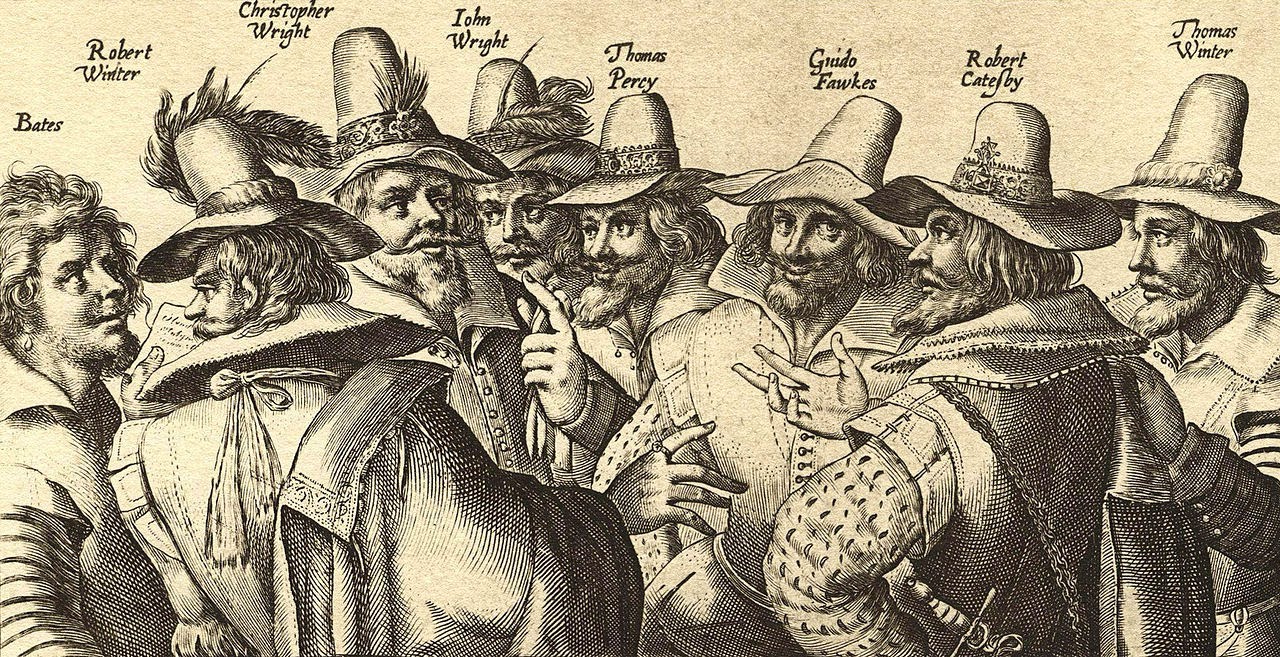
Guy Fawkes Day, also known as Bonfire Day, is a curious holiday.  It commemorates the failure on 5 November 1605 of the Gunpowder Plot, a scheme by a group of Catholics to blow up parliament and the Protestant King James I.  The plotters were betrayed, the barrels of gunpowder under the House of Lords were discovered in time, and the king's life was spared.

Members of the Gunpowder Plot
I find this a curious occasion to commemorate because it conforms neither to the major trend in holidays, nor to the primary exception.  Most holidays celebrate glorious triumphs such as victories in battle (e.g. Lepanto Day / Feast of the Holy Rosary), political successes (usually independence), or momentous spiritual events (e.g. the Incarnation or the Resurrection).  Some holidays, such as Thanksgiving, do not celebrate a particular triumph, but point to successes generally.  Apart from this major trend of celebrating victory, there is an exceptional category of holidays, which recall tragic failures, either gloriously defiant (e.g. the Alamo or the July 20 Conspiracy), or horrors from which we have, broadly speaking, taken some meaning or learned some lesson (e.g. Good Friday, September 11th, or Memorial Day).

But why do the English celebrate Guy Fawkes Day?  One might say it has become little more than an excuse for fireworks and bonfires, and this is probably true, but it only pushes the question to one step remove: why this day, and not some other?  The failure of the Gunpowder Plot was as much the fault of bumbling plotters as it was as success for the Crown and its supporters.  More to the point, the Plot was defeated not in honest battle or by national effort, but by shadowy intrigue.  Hardly the stuff of most victories.

Guy Fawkes Day, Lewes, England, 2011
Sadly, the real reason Guy Fawkes Day may have caught on in England is that it offered a chance to spite Catholics.  Indeed, the centerpieces of Guy Fawkes celebrations has traditionally been the burning in effigy of Mr. Fawkes and the pope.  Although other figures are often substituted today, this makes the holiday more than a tad bit awkward for Catholics.

But I have come to see the need for a third kind of holiday, the commemoration which does not yet possess resolution.  Perhaps my recent excursions into the historical books of the Old Testament have pushed me in this direction, for they are mostly filled with rebellions, defeats, and exile, epitomized by  Psalm 137: "By the waters of Babylon, / there we sat down and wept, / when we remembered Zion. / On the willows there we hung up our lyres. / For there our captors / required of us songs, / and our tormentors, mirth, saying, / 'Sing us one of the songs of Zion!' / How shall we sing the Lord’s song / in a foreign land?"  We have a small appetite for commemorating such events when they are recent, though memory quickly fades.  But history is replete with such calamities.  The burden of history, though it need not be overwhelming, certainly rests heavy on us, if only we open our eyes to see it.

For me, Guy Fawkes Day commemorates the difficulty of living in the world but not of it.  It commemorates the confusion that results when trying to square the demands of eternal faith with the demands of temporal politics.  It commemorates well-intentioned devotion gone awry.  It commemorates the reality that my co-coreligionists have undertaken actions I cannot always explain or justify.  It commemorates divided Christendom.  This is, or should be, a painful open wound.  Although there are lessons to be learned, I do not think we are yet at the point where we can say that we have learned them.  For now, we must simply recall.  We must bear the weight of history and trust that wisdom, some day, will follow.

Wednesday, July 16, 2014

My Short Reading List - Foreign Policy

As you might have guessed, I am a bibliophile.  I collect not only physical books but also lists of them: favorite books of various genres, books I recommend, books I'd like to read.  At one point my Amazon Wish List fulfilled this last function.  In some sense it still does.  But over the last several years this Amazon list has grown far faster than I could possibly keep up with.  It has been subdivided into various daughter lists, each of which now grows at a similarly impossible pace.  It is no longer primarily a collection of titles I would like to own or even read any time soon; rather, it is home to various titles I would like to remember for various reasons, mostly because they come strongly recommended by authorities I trust (though, admittedly, often very diverse authorities).

Hoping that perhaps others could make use of this conglomeration, even if I can do so only rarely, I have decided to share these lists here, for your perusing pleasure, in several installments, beginning with foreign policy.  I think you'll find them a far-flung bunch.  Perhaps you'll see something of interest to you and pick it up.  If you do, please, let me know what you thought.  And if you've already read some of these titles, likewise, please, share a short review.


Military History, pre-1900.  So vast is my interest in military history that I eventually had to bifurcate it.  This list runs the gammut from the ancient world, through the medieval period, all the way to the likes of the American Civil War.  It includes Michael Decker's The Byzantine Art of War, William Dalrymple's Return of a King: The Battle for Afghanistan, 1839-42, Robert Tonsetic's Special Operations in the American Revolution, and others.

Military History, 1900-present.  This list is my natural intellectual home.  My dissertation on the origins of Britain's Special Operations Executive (SOE) included discussions of conflicts in Europe, Africa, the Middle East, South Asia, and East Asia in the four decades preceding the Second World War and how lessons from those conflicts were applied by the Allies.  This list covers similar ground.  It's heavy on the Second World War and the British Empire in the 20th century (yes, including decolonization).  It includes a look at the Polish-Soviet War, studies of the role of the US Navy in the Allied Intervention against the Bolsheviks and on the Yangtze in the 1930s, several works on Japan and its war in China, and a history of the Stauffenberg family, one member of which tried to assassinate Hitler (about whom I have written).  Other intriguing reads on this list include David French's The British Way of Counter-Insurgency and an account of Karen rebels in Burma (for whom I have a soft spot).  The list also includes works on the Global War on Terror.

Diplomacy & International Affairs.  This list includes theoretical works (such as The Routledge Handbook of Religion and Security), books on historical case studies (including Foreign Affairs and the Founding Fathers and The Russo-Turkish War of 1877-1878 and the Treaty of Berlin), and biographies of both American and foreign statesmen (among them Castlereagh, T. E. Lawrence, and the little-known Frank McCoy).  You'll see that, among other topics, I'm intrigued by Southeast Asia.

Intelligence.  Much of this list's potential material is covered in the above categories, but it includes a few intriguing titles, some critical (e.g. The Human Factor: Inside the CIA's Dysfunctional Intelligence Culture), some historical (The Archaeologist Was a Spy), others decidedly non-Western (Intelligence Elsewhere: Spies and Espionage Outside the Anglosphere).

Wednesday, July 2, 2014

The Shield of Faith - An Update

Six years ago I wrote a post about St. Paul's admonition to the Ephesians to "hold faith as a shield, to quench all [the] flaming arrows of the Evil One." In that post, I highlighted the communal value of shields in the Greek-speaking world, as when wounded Odysseus "called... [and] Aias came near him, carrying like a wall his shield, and stood forth beside him" to protect him from the Trojans. At the time, I thought this intercessory quality of faith, by which we are protected by the faith of our brothers, was a novel reading of this passage. Not so, I discovered.


Around AD 740, three monks - Denehard, Lullus, and Burchard - who assisted St. Boniface in his missionary work in Germany, wrote to Abbess Cuniburg in England. One of their requests to her was that "you will not refuse to shelter us against the cruel darts of sin with the shield of your prayer," a clear reference to Ephesians 6:16.

As Christians are suffering persecution around the world, and in many cases dying for the faith, please remember them in your prayers and extend the shield of your faith over them.

Friday, May 2, 2014

The Athanasian Creed

Today we celebrate the Feast of St. Athanasius (c. 297-373).  While most Christians know the Nicene Creed and the Apostles Creed, less well known is the third of the orthodox creeds, attributed to St. Athanasius.  Whether he actually wrote it is a matter of some debate, but it certainly coheres with the theology he articulated (as well as the long sentences of his Greek!).  Whereas the other creeds focus more on the life of Christ, this one focuses primarily on the two great mysteries of the Christian faith, the Trinity and the Incarnation.


Whosoever will be saved, before all things it is necessary that he hold the Catholic faith,
which faith except every one do keep whole and undefiled,
without doubt he shall perish everlastingly.

And the Catholic faith is this: That we worship one God in Trinity, and Trinity in Unity,
neither confounding the persons nor dividing the substance.
For there is one person of the Father, another of the Son, and another of the Holy Spirit.
But the Godhead of the Father, of the Son, and of the Holy Spirit is all one,
the glory equal, the majesty coeternal.

Such as the Father is, such is the Son, and such is the Holy Spirit.
The Father uncreated, the Son uncreated, and the Holy Spirit uncreated.
The Father incomprehensible,
the Son incomprehensible,
and the Holy Spirit incomprehensible.
The Father eternal, the Son eternal, and the Holy Spirit eternal,
and yet they are not three eternals but one eternal.
As also there are not three uncreated nor three incomprehensible,
but one uncreated and one incomprehensible,
so likewise the Father is almighty, the Son almighty, and the Holy Spirit almighty.
And yet they are not three almighties, but one almighty.

So the Father is God, the Son is God, and the Holy Spirit is God;
and yet they are not three Gods, but one God.
So likewise the Father is Lord, the Son Lord, and the Holy Spirit Lord;
and yet they are not three Lords but one Lord.
For like as we are compelled by the Christian truth
to acknowledge every Person by himself to be God and Lord;
so are we forbidden by the Catholic religion to say: There are three Gods or three Lords.

The Father is made of none, neither created nor begotten.
The Son is of the Father alone; not made nor created, but begotten.
The Holy Spirit is of the Father and of the Son;
neither made, nor created, nor begotten, but proceeding.

So there is one Father, not three Fathers;
one Son, not three Sons;
one Holy Spirit, not three Holy Spirits.
And in this Trinity none is before or after another; none is greater or less than another,
but the whole three persons are coeternal and coequal,
so that in all things, as aforesaid,
the Unity in Trinity and the Trinity in Unity is to be worshipped.
He therefore that will be saved must thus think of the Trinity.

Furthermore it is necessary to everlasting salvation
that he also believe rightly the incarnation of our Lord Jesus Christ.
For the right faith is that we believe and confess
that our Lord Jesus Christ, the Son of God, is God and man.
God of the substance of the Father, begotten before the worlds;
and man of substance of His mother, born in the world,
perfect God and perfect man, of a reasonable soul and human flesh subsisting,
equal to the Father as touching His Godhead,
and inferior to the Father as touching His manhood,
who, although He is God and man, yet He is not two, but one Christ;
one, not by conversion of the Godhead into flesh, but by taking of that manhood into God;
one altogether, not by confusion of substance, but by unity of person.
For as the reasonable soul and flesh is one man, so God and man is one Christ,
who suffered for our salvation, descended into hell, rose again the third day from the dead.
He ascended into heaven, He sits on the right hand of the Father, God, Almighty;
from thence He shall come to judge the quick and the dead,
at whose coming all men shall rise again with their bodies
and shall give account of their own works.
And they that have done good shall go into life everlasting
and they that have done evil into everlasting fire.

This is the Catholic faith, which except a man believe faithfully he cannot be saved.