Showing posts with label British Empire. Show all posts

Wednesday, February 15, 2017

Beautiful Indian Summers - But to What End?

A little while ago my wife and I began watching Indian Summers, a show about the British Raj's annual move to Simla, in the foothills of the Himalaya, where it sheltered from Delhi's summer heat. The show is visually stunning, marked by the natural beauty of the landscape (actually shot in Malaysia) and the pomp of the Raj. For a historian of the British Empire, the draw is obvious. But we've been on an Indian Summers hiatus of late. By tacit agreement, we just started doing other things in the evening.

The show's characters, though interesting, may have missed a certain je ne sais quoi. The plot, though intriguing, was not quite compelling. But my disquiet about the show was something else. Something more fundamental.

Friedrich Nietzsche, in his Advantages and Disadvantages of History for Life, described three kinds of history. Monumental history glorifies the past; it holds up the heroes of yesteryear as models to be imitated. Critical history highlights all that was wrong in the past, and in so doing spurs us on to do better today. Antiquarian history is less dynamic: it describes the past as essentially the same as the present. It takes comfort in the great continuity of human society.

Viewed through this lens, Indian Summers is puzzling. It is not monumental. Although the splendor of the Raj is on display, the show clearly conveys that the Raj was oppressive, dishonest, and generally out of touch with the people it governed. And yet I would hesitate to describe the show as critical. The Indian nationalist movement - at least in the episodes we watched - comes off as morally justified, but not dramatically so, not enough to decisively turn our sympathies against the British characters. Given the enormity of the questions at stake, there is a surprising amount of moral ambivalence.

So Indian Summers must be antiquarian, right? Here we come to the crux of my complaint. At first glance, the show would not seem to fit the basic antiquarian mold: its power struggles, deceptions, and unbridled lust for power and the pleasures of the flesh bear little resemblance to my own life. Is this essentially the same as the present day?

Indian Summers is a mirror reflecting many of the worst qualities of 21st century America. The quest for power is taken as a given. Fornication and adultery are essentially no different from a good meal: if the cost is not unreasonable, well worth enjoying. Truth and justice, though not entirely banished, have become moral garnishes. For those who live in this version of modern society, Indian Summers conveys the message that the Raj looked much like the present. That which is enjoyed or feared, valued or despised today was held in similar regard in every age, was it not?

But for those of us who still inhabit those corners of contemporary society where desires are subordinated to duties, where power has value only in relation to the ends it accomplishes, where fidelity is not merely a burden to be carried but a virtue to be celebrated, Indian Summers is a depressing scene. That these shortcomings are not even recognized is more depressing still.

Tuesday, May 24, 2016

Empire, Brexit, and the Historical Imagination


Today is Queen Victoria's birthday, a public holiday in Canada (observed on the preceding Monday) and the anchor point for the moving Empire Day holiday (which subsequently morphed into Commonwealth Day).

Debates about the British Empire - was it a monument of civilization or a system of global oppression? - have reminded me of debates about a more contemporary question: Brexit. Does Britain belong in Europe or not?

In a recent Financial Times article, Gideon Rachman examined the claims of two rival camps of historians as they argue about whether Britain has, historically, been part of Europe. Historians for Britain, the euro-skeptic party - led by David Abulafia, professor of Mediterranean history at Cambridge - contend that Britain has a long tradition of political continuity and moderate reform (unlike Europe, with its revolutions and reactions, not to mention Fascism, Nazism, and Communism), as well as physical separation from the European continent.

The pro-European party - which lacks a handy label, but did put out an article titled "Fog in Channel, Historians Isolated" - takes issue with these claims, noting that Britain has a long history of close interactions with the Continent. Not least among such linkages is Christianity, integral to Britain's identity, at least until quite recently, but also something to which Britain has no unique claim, but instead shares with the rest of Europe and regions beyond. Moreover, the critics note that Britain had a civil war, which, though several centuries ago, was no less nasty for its antiquity.  So Britain is not immune to such upheavals. And then there's the Empire. "Expropriation, slavery, massacres, oppression, anyone?” asks Neil Gregor, professor of modern history at Southampton.

Rachman concludes that "I do not entirely agree (or disagree) with any of the historians I have met... [but] I agree with Abulafia and the Historians for Britain in one important respect: their argument that the UK has been unusually good at creating successful political institutions and that this is an inheritance worth cherishing and protecting." However, Rachman adds: "But I do not think that this adds up to an argument for Britain leaving the EU."

I would like to pull the lens even further back, so to speak. Ever since Leopold von Ranke (1795-1886), the father of the modern historical craft, we - I say this as a member of the historical guild - have focused on history wie es eigentlich gewesen (as it actually happened). This is a perfectly reasonable and laudable standard for historians to pursue. But as Friedrich Nietzsche (1844-1900) reminds us, history also has advantages and disadvantages for life. I would not go so far as to say, as Nietzsche might, that we should falsify the historical record for the sake of the impact it has on the present. But we would be fools to overlook the role that perceptions of the past have in shaping our imaginations, which in turn shape our actions.

In this context, I would argue that emphasizing Britain's long history of evolving, moderate, and generally freedom-loving political institutions is useful, even inspiring, for Britain's present, whether that be within or outside the EU. In a similar vein, I think a case can be made that emphasizing the British Empire as a global effort at fostering trade, harmonizing law, ensuring security, and spreading the Gospel is a worthy means of inspiring the men and women of today to deeds of virtue.

You might contend that these visions of Britain's past are as much romance as fact; I would suggest they are simply the product of particular emphasis. But what about all the failures that went along with these positive elements? Ah, you are putting on your critical history hat, as Nietzsche would say. As I pointed out five years ago, we can do that tomorrow. Today we celebrate the good.

Today's image comes from the Canadian War Museum.

Tuesday, May 24, 2011

Happy Empire Day!


Today is Queen Victoria's birthday. It would have been her 192nd, but all good things must come to an end, and in the case of her life, that happened in 1901. However, the day lived on as Empire Day, a celebration of the British Empire.

Perhaps you are wondering why I, an American, am celebrating the Empire. After all, isn't American Independence Day a repudiation of the Empire? Americans sometimes think of themselves as heirs to the British tradition of representative government, trial by jury and free enterprise. Less often do modern day Americans think of themselves as heirs to the Empire, but I am willing to argue just that.

Let me highlight this phenomenon with regard to just one imperial possession, India. As a child, I grew up playing both Parcheesi and Carrom; at the time I knew that the former was Indian in origin (known there as "Pachisi"), but I found out only last year that the latter is also an Indian game. As a child I also played chess (a game of Indian origin, though much earlier than the Empire) and I once came upon a special variant of the game called Maharaja. What is striking, in retrospect, is that at a young age I knew what a maharaja was, probably because of this comic. Likewise, as a child I was taught to despise thugs, wash my hair with shampoo and wear pajamas, though I had no idea that any of these words came from Hindi. As an adult I took to wearing seersucker, including on my visit to Jordan (another imperial holding, taken from the Turks by imperial troops, but I digress); this too is a product of the Raj. The world is simply too interconnected for Americans to think they have nothing to do with Britain's historical role in Africa, Asia and far-flung corners of the world.

In 1958 Empire Day was renamed Commonwealth Day and since 1976 the Commonwealth has celebrated it on the second Monday in March. But being a man of history, I have a certain nostalgia for the old things. This is not to say that all the Empire did was good or right, but today we choose to remember it at its best; tomorrow we can criticize, if we must.


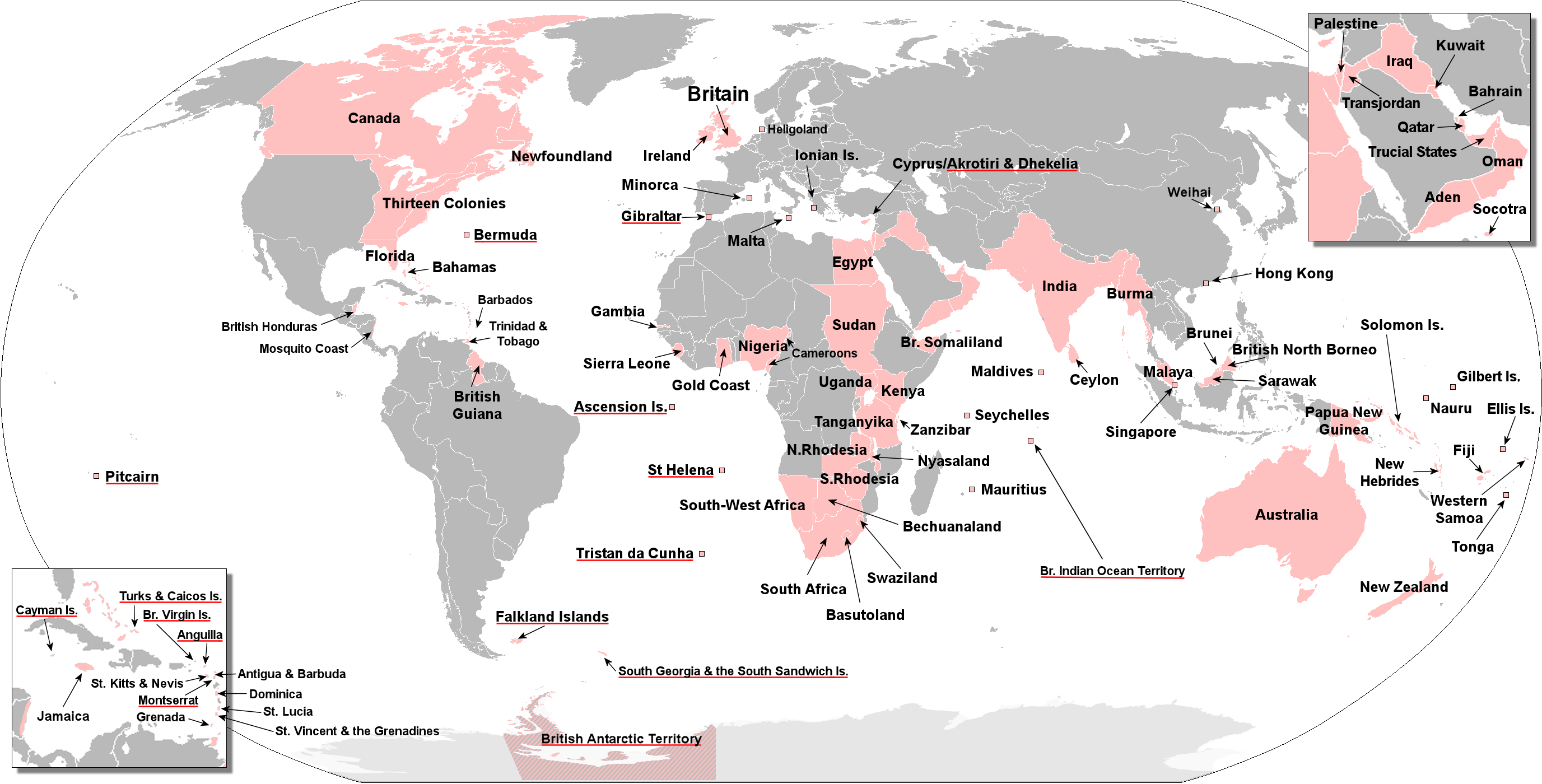
Today's image of Queen Victoria comes from BritishMonarchs.co.uk. The lovely map comes from the University of West Georgia's Readings in the History of the British Empire. Lovely though it be, it does not show the Empire at its fullest extent; for that, click here.

Monday, February 8, 2010

Music from the Empire


The other evening, after a lecture by the Chief of the Defense Staff of the Canadian Forces, I was working on a book review about Ireland for the Canadian Journal of History, reading up on British history for my comprehensive exams and outlining a course covering British counterinsurgency in South Africa, Ireland, Malaya and elsewhere. In keeping with the mood, I put on a variety of music from around the Empire, some of which I thought I would share here. (Be warned: some typically cheesy slideshows - the price of finding music on YouTube - follow. However, the Bok van Blerk video is pretty cool.)

Bok van Blerk - De La Rey

This song is a tribute to Koos de la Rey, a Boer general during the Second Anglo-Boer War (1899-1902). The song has been a source of some controversy, not so much because of what it says about the past, but because of what it may (or may not) say about the present. If you'd like a translation of the Afrikaner lyrics, there are some subtitles here.

Scotland the Brave

This pipe tune was written around 1900. It is the regimental quick march of the Royal Regiment of Scotland and has spread sufficiently far that it is the pipe march of the British Columbia Dragoons and is played at the Citadel in South Carolina. (Notice that this rendition is performed by the Royal Tank Regiment's band.) In the course of its history, lyrics were written for the tune, first by Cliff Hanley and most famously by John McDermott (whose version sometimes goes by the title of Scotland Forever). The McDermott version has a particular place in my heart because of a little episode which took place in Germany in the summer of 2004. I was out hiking with a few Germans, some other Americans and a fellow from Singapore. At one point in the hike I began whistling Scotland the Brave and the Singaporean chimed in; soon we were singing our way through several verses together. The Germans inquired as to what we were singing, and when we told them it was a Scottish song they were rather baffled: neither of us were from Scotland, nor were we even from the same country (or the same side of the globe!). How was it that we both knew this song? The broad spread of Anglophonic culture was a marvel they could not quite understand...

Stan Rogers - Barrett's Privateers

Though the characters and ship involved in this song are fictional, the circumstances were quite real: during the American Revolution, a large number of privateers sailed on each side, with Halifax serving as a major center for British vessels. Roger's effort to breath new life into Canadian folk culture by means of traditional musical styles and themes from Canadian history is quite interesting, probably worthy of a blog post itself, though I'm afraid I'm not the one to write it.


Show of Hands - Roots

This song saw some controversy when the dubious British National Party picked up the music of Show of Hands and other British folk groups (including Fairport Convention), unbeknown to the artists. When the musicians found out, they were not happy, the Telegraph reports. However, a careful listen reveals that the lyrics, though proud of England and her traditional culture, are hardly the stuff of white supremacy. Indeed, they look admiringly to other cultures which have more effectively preserved their folkways.