Wednesday, August 11, 2010

Josef Pieper: The Other’s Right (III)


...continued from Part II:

Before I do that, however, one more rather aphoristic observation on another point of the ancient doctrine of justice which, so it seems, should surely arouse more curiosity than it usually does. I mean the name by which the fundamental act of justice is generally named. Its name is: restitutio, a restoration, then, a giving back, a reparation, a “making-good-again.”

One might ask: What does this “again” actually mean? Yes, when someone gives something back which he unjustly took for his own, or when someone compensates, or tries to compensate, for damage or an injustice he inflicted on someone else—we then speak of restitutio, of making good again; this is a clear case. But according to the ancients the giving of what is due always has, in every case, the character of restitution; surprisingly so, one thinks. But in reality this same surprise is hidden in the common phrase according to which justice consists of giving to each man what is due to him. Schopenhauer posed the question: “When it is his, why must someone first still give it to him?” How (in other words) can something be “his” and at the same time be something that must be given to him, and so obviously something that he has not yet come to possess or no longer has?

The realization of justice really does seem to presuppose that the state which is actually proper to the essence of human community, which for that reason can also be considered the original or “paradisiacal” (so to speak), does not exists (or: no longer exists), that it has been upset and must therefore be restored after the event. That upsetting must not necessarily be understood as the infringement of one’s rights. Every human action “upsets” in a certain sense the condition at a certain time, the static condition of balance. Goethe, to whom is attributed the saying that “[t]o become a man means learning to be unjust”—Goethe says (in Elective Affinities): “A man may withdraw from life into oneself as much as possible, but before he knows it, he has become a debtor or a creditor.” But inasmuch as this happens (that men, simply by being active, continuously contract debts with each other), the challenge comes ever closer to us, to “restore” the condition of balance by rendering and paying what we owe.

Yet it is not to point out these more or less trivial and obvious facts that I lay my finger on the concept of restitution. Rather, I wonder whether this concept, upon which the ancients insist with an odd exclusivity, might not imply a certain, very general idea of the form of all historical action, namely the conviction that in human society the state of everyone being quits with everyone else, of a complete balance of demand and payment, i.e. of justice, can never be definitively “set up” once for all; that rather this state must always be restored “anew,” iterato; that, in other words, the reductio ad aequalitatem, which occurs through restitution, is in principle an unending task. By this we are to understand that what on first appearance is so unimpressive, that the lack of finality, the provisional, the makeshift, constant repairs and patch-up jobs simply belong to the essence of man’s historical activity and to the fundamental condition of the world he has been entrusted with, whereas the militant assertion of exactly defined plans or from final eschatological orders, whereby justice on earth should be established and produced once for all, must of necessity lead to inhumanity (which in fact has been clearly confirmed by mankind’s not inadequate experience).

This is, one will admit, an all-encompassing view of the world and history, a conception of a certain explosive relevance today. But it is precisely this conception, I believe, which lies hidden behind the old, perhaps all too harmless, pedantic-sounding teaching, according to which the fundamental act of justice possesses the inner form of restitution, of making good again.

Tuesday, August 10, 2010

Josef Pieper: The Other’s Right (II)


...continued from Part I:

Obviously, in such times as these we cannot dispense ourselves from discussing the most profound and ultimate justification for the inviolability of what is due to man; of course, it is not enough that it be discussed; rather, by using every means available for something like this, society must be made aware and kept aware of the insight that something is inviolably due man, because behind man stands a tribunal beyond all human discussion; because, to say it differently and more clearly, man is created by God as a person. This and nothing else is the lone, ultimately valid justification for the inviolability of the obligation to justice. This of course does not mean that an “atheist” cannot be just, just as it does not mean that “theists” must be especially just. We need not waste another word about that.

Yet, if that ultimate reason for the obligation to justice really were to disappear completely from man’s consciousness, something could happen that no longer seems utterly beyond our experience: not only will the executioner not know and not want to know why something is due to his victim, but also the victim will potentially no longer be able to explain why he is suffering injustice.

One may not object that such a grounding of the obligation to justice by falling back upon an absolute authority is something specifically Christian or theological. Indeed, the very same Asian, who was a member of the UNESCO Commission explained that though the phrase “human rights” does not appear in his language and tradition, the matter it concerns does—this Chinaman quoted to his colleagues a sentence, which, as I can well imagine, was received with some puzzlement, and which was taken from the millennia-old “Book of History”: “Heaven loves the people, and the ruler must obey heaven.” That is, as one sees, essentially the same foundation for the obligation to justice known to the Christian-Western tradition, in which it has found a particularly clear and profound formulation, but not at all only in doctrines of justice based on theological arguments. The following sentence, for example, expresses the same thought: “We have a holy ruler, and that which he has given to men as holy is men’s right.” This sentence, however, is not to be found in a theological Summa from the thirteenth century, but rather in Immanuel Kant’s lecture on ethics, who thereby also teaches that man’s right requires, as its final guarantee, a refuge in an absolute, divine ground.

I said, when the old doctrine of justice spoke of right, then it meant “the other’s right,” and nothing besides that. Justitia est ad alterum; this sentence, according to which justice essentially has to do with the other, has more than just one aspect. Surprisingly, for example, this otherness is to be taken much more precisely and literally than one would immediately suspect. It is indeed this, it is said, which distinguishes the structure of justice from the situation of love: the partner formally confronts me “as” other.

Of course, there is another concept of justice which does not exclude love, just as there is a concept of love which includes that of justice. Whoever grasps the distinguishing characteristic, the differentia specifica, must simply see that love has nothing to do with an “other” or with a “stranger,” but with someone who belongs and is bound to him; lovers do not say to each other: “This is due to me, and that to you.” Rather, they say: “All of this is ours.” Lovers give each other gifts; the act of justice, however, is not the giving of a gift, but the paying of a debt. When the ancients insist on this distinction, not only a need for conceptual exactness is in play, but a completely illusion-free idea of reality as well. To be just means: to recognize exactly where one cannot love. This is precisely what the demand contained in this picture of justice signifies: confirm the other in his otherness and help him to obtain what is due to him.

Spelling out what is apparently obvious will not appear superfluous once one remembers that the term “liquidation” has entered into men’s mental vocabulary—and not just the concept, but the reality. “Liquidation” signifies not so much a punishment, or even an execution; “liquidation” means: extermination because of otherness. And it would be, I believe, simply unrealistic, not to acknowledge that this impulse—“whoever is different must be liquidated”—shapes and threatens man’s thought like a poison, or at least as a temptation, perhaps ever since the beginning of the world, perhaps ever since Cain, but especially in our own time. That is the reason why it is still important to name the most elementary components of the ancient concepts of “justice” and to keep them present in our minds. It is the “other,” indeed the “stranger,” who is explicitly meant as the partner of the man who is called to justice—the man who actually “stands off at a distance” or also the man who is mentally perceived as a “stranger,” the man who perhaps unintentionally makes his appearance as our competitor or as a threat to my own interests, to whom it would never occur to me to give a gift, against whom I must hold firm and assert myself: To give even him what is due to him, not more, but not less—that is the achievement of justice.

If one considers the matter from the other shore (so to speak), from the side of the receiver, of the man with a right, then the distinction between the gifted and the debtor proves to be quite acute. Everyone knows the formula: I don’t want any charity, I want my right—whether it deals concretely with the Christmas bonus or foreign aid for development. Even the one who is “gifted” (in quotation marks!) feels that he has been unjustly treated; he wants nothing more than what is due him; but he wants everything that is due. Perhaps he is not wrong.

Yet it is just as evident that we have unintentionally touched upon the most sensitive points of man’s communal life. The inability and the refusal to accept a gift; the unwillingness to show gratitude (why should one express thanks when he is only being paid what is due him?)—all these are after all somewhat problematic things. But in all of them there arises a concern about first principles, namely the question whether perhaps justice, however much it forms the metallic core of all communal life, could nevertheless not be enough for the realization of a truly human existence among men. As a matter of fact, the ancients are of the opinion that justice is not sufficient. (I will have a word to say about this at the end of this reflection.)

Monday, August 9, 2010

Josef Pieper: The Other’s Right (I)


Note: The other day I was going through some old files from my time in Germany and I found this translation of a lecture by Josef Pieper on the nature of justice and human rights. I’m not exactly sure anymore why I went to the trouble of translating it (other than that I really like Pieper), but I think that some of our readers might appreciate it. It’s a bit long, so it will appear in five parts.

The original text is Josef Pieper, “
Das Recht des Anderen,” in Über die Schwierigkeit, heute zu glauben. Aufsätze und Reden (Munich: Kösel-Verlag, 1974), pp. 224-242.


In the years immediately following the Second World War, as is well known, a UNESCO committee was assigned the task of preparing a new formulation of “human rights.” During the committee’s consultations something strange, but noteworthy, happened. The Chinese delegate, a philosophy professor from the not yet Communist China, brought it to the committee’s attention that his country’s language did not even have a word for what they were discussing; the concept of “human rights” was not found in the Chinese tradition. What was meant by the term was, of course, not a completely foreign idea, but was viewed from a different perspective. From which perspective, I will speak about that in just a minute.

I suspect that this information—which was presented with obvious embarrassment—caused not a little wonder; perhaps a few more or less plausible historical-sociological explanations were immediately available. It seems to me, though, that we should not brush this matter aside too quickly. What is actually worth consideration is that the matter does not look all that different in our own great European intellectual tradition. The ancient doctrine of justice (whether we ask Plato—who is not just anyone; the Harvard philosopher Alfred North Whitehead has called all of Western philosophy a collection of footnotes to Plato, which is a little too extreme for me—whether we ask Plato or Aristotle or Cicero or Augustine or the law book of the Roman Empire, the Corpus Juris Civilis, or the great teachers of medieval Christendom)—the ancient doctrine of justice spoke very emphatically of what was inviolably due to each man; but by the same token it also never developed a doctrine of “human rights,” at any rate not formally.

It would be quite meaningful, it seems, to recall a few aspects of this doctrine of justice—forgotten, but especially relevant today—in an essay which will necessarily be more aphoristic than systematic.

The “ancients” (by which of course I mean not the dead, but the “greats,” the great witnesses especially of our own tradition), the ancients, when they speak of justice, never consider the man who has a right, but rather the man who has a duty. The just man’s concern, they say, is to give what is due, not actually to receive it; and to be deceived about what is due to oneself is something completely different from withholding, detracting from, or taking away what is due to another person. “This sentence has already been repeated many times,” says Socrates in the Platonic dialogues, “but it can always be repeated without harm: the man who commits injustice is worse off than the man who suffers injustice.”

The ancient doctrine of justice is, once more, not primarily a statement of rights, to which one is entitled and should lay claim; rather, it is the statement and explanation of obligations, of rights to be respected—whereas the later, more familiar doctrine of human rights, does not appear to focus on the man with obligations, but on the man with rights. Of course, obligations and the man who is obliged are not completely neglected, just as the man with rights is not completely neglected in the old doctrine of justice. However, there is an unmistakable, characteristic shifting of the accent—it may be hard to interpret, but it is still worth taking notice of it.

This shifting of the accent forces itself upon one, with no special attention necessary, if one just leafs through the Declaration of Human Rights passed by the UN: “Every man is entitled to. . ., every man has a right to. . . life, freedom, security, the protection of the law, to freedom of movement, to freedom of assembly, to work, to relaxation,” and so forth. This obvious change in perspective, whatever it might imply and however it should be interpreted, interests us not for the sake of a moralistic and quite problematic praise of “the good old days.” Of course, it begs the question whether the proclamation of rights, which appears so aggressive at first, does not rather come from a basically defensive attitude, or even one of resignation—because, strictly speaking, justice belongs only to those who are capable of granting or denying what is due, through which action each person receives what is his due. Is it not more daring and aggressive, but also more realistic, to make room for this old view of justice by attempting to activate the person who is obliged to fulfill a duty, that is, everyone? Such an attempt will naturally lead to nothing, if one limits oneself to talk. It depends on presenting, in a convincing way, the basis for obligation and the inviolability of what is due.

For according to the ancients justice is essentially something second; it depends on a condition and rests on a foundation: someone else is there, to whom something is inviolably due. One can also formulate it this way: When the ancients speak of a right, then it is always and exclusively the “other’s right” which they mean. The question why, how, and on what grounds something is due to the other, every other person with whom I deal—this question is very decisively answered in their doctrine of justice and with a radicalness which both appears worth thinking about and which it is possibly vital to recover. Finally, in our recurring experience, the appeal to “human rights” does not achieve anything. And insofar as human nature is understood as the ultimate justification of this right, it is no wonder that it is so. Of course, Nikolai Hartmann is right when he says that justice has to do with respecting “the person’s sphere of freedom”; and, of course, something is inviolably due man because he is a “person,” i.e. a being that by nature exists for the sake of its own fulfillment. Nevertheless, these are not ultimate, but penultimate justifications; and falling back on them is simply not enough today—today, that means in an age, in which extreme denials [of the other's right] have emerged and in which, not merely because of a purely empirical barbarization of power but because of programmatic theories, man is treated as if he were not due anything.

Thursday, August 5, 2010

Lord Franklin


Aaron's post yesterday about the fabled Northwest Passage, and Stan Rogers' song about it, brought to my mind a common folk song about one of the men who went searching for it: Sir John Franklin.

Lord Franklin set sail from England on May 19, 1845. After sailing past Greenland, they become ice-bound somewhere past Baffin Bay. None of the crew, including Lord Franklin, was seen alive again. A note, however, was later found on Beechey Island, stating that Lord Franklin died on June 11, 1847.

After no word after a couple of years, a search party was sent out, but none of the crew--besides a few graves--was found. The mystery surrounding the voyage to the Northwest Passage captured the public's imagination, and within a few years an anonymous musician wrote a song about it, describing the fear that Lady Franklin must have felt waiting for news about her husband.

The first version of this song comes from the English folk-rock band Pentangle, which at the time featured two superb guitarists: John Renbourn and Bert Jansch. Their version of this song contains a very restrained, and very tasteful, guitar solo.


The second version comes from Mícheál Ó Domhnaill, the late Irish singer best known for his work with the Bothy Band. He was (I have heard) a great admirer of Renbourn and Jansch's work with Pentangle, and I suspect it was the above version that inspired him to do something unusual for him: sing in English. He recorded it with fiddler Kevin Burke on their 1979 duet album Promenade.

Wednesday, August 4, 2010

Northwest Passage - Annotated


Early this spring I woke up with the chorus to Stan Rogers' "Northwest Passage" rolling through my head. In that state of semi-consciousness I must have mumbled my way through it at least a half dozen times before I realized what was going on. When a song has weaseled its way that far into your psyche, an annotated edition is in order...


Chorus:
Ah, for just one time I would take the Northwest Passage
To find the hand of Franklin reaching for the Beaufort Sea;
Tracing one warm line through a land so wild and savage
And make a Northwest Passage to the sea.

Westward from the Davis Strait 'tis there 'twas said to lie
The sea route to the Orient for which so many died;
Seeking gold and glory, leaving weathered, broken bones
And a long-forgotten lonely cairn of stones.

Chorus

Three centuries thereafter, I take passage overland
In the footsteps of brave Kelso, where his "sea of flowers" began
Watching cities rise before me, then behind me sink again
This tardiest explorer, driving hard across the plain.

Chorus

And through the night, behind the wheel, the mileage clicking west
I think upon Mackenzie, David Thompson and the rest
Who cracked the mountain ramparts and did show a path for me
To race the roaring Fraser to the sea.

Chorus

How then am I so different from the first men through this way?
Like them, I left a settled life, I threw it all away.
To seek a Northwest Passage at the call of many men
To find there but the road back home again.

Chorus


Hat tip to Mike and his Sea of Flowers blog, which untangled the mystery of that phrase and its relation to "Brave Kelso." Alas, it would seem Kelsey never wrote the line "sea of flowers," instead describing the prairie as a bleak place. The kind of language Rogers employs is more reminicent of William Cullen Bryant, who in "The Prairie" described the plains "In airy undulations, far away, / As if the ocean, in his gentlest swell, / Stood still, with an his rounded billows fixed".

Friday, July 23, 2010

Rejoicing Correctly


One of the oddities of Aristotle's Politics--at least for the modern reader--is that it ends with a somewhat lengthy discussion of music, which would have been even lengthier if the complete work had come down to us. But when we remember that Aristotle was a student of Plato, who taught that "the ways of poetry and music are not changed anywhere without change in the most important laws of the city," we will begin to see why Aristotle placed so much importance on the role of music in the polis.

Aristotle, like his teacher, recognizes that music has a profound power. But what is this power good for? Aristotle rejects the idea that music should be a mere amusement like "sleep and deep drinking" (Bk. VIII.iv.3;1339a17), or even that it should be an intellectual entertainment for the cultured (1339a25). Instead, he emphasizes its formative influence on the soul, and its ability to help the young develop virtue.

But, virtue sounds boring, and it also sounds like hard work--which Aristotle admits, when he calls education in virtue a "painful process" (μετὰ λύπης γὰρ ἡ μάθησις). So, why regulate music in what is bound to be a painful process for the young?

Aristotle's answer is simple, but profound: Music must be regulated so that the young can learn to "rejoice correctly" (χαίρειν ὀρθῶς). Good music helps the young to govern their emotions, and to attain happiness. In a later part of the discussion, Aristotle repeats this very same phrase phrase, and then adds two more emotions that need to be learned correctly: love and hatred (1340a15).

So, why should we pay attention to what kind of music we listen to? So that we can love, hate, and rejoice correctly.

Tuesday, July 20, 2010

Top Five (slightly obscure) Sporting Events I'd Like to See


No. 5: The Eton Field Game. This is not a single event, but a highly specialized sport all its own. The Eton Field Game is two parts soccer, and one part rugby, with a huge dose of preppy. Played only at Eton College, the game has been going on since at least 1815 and is played by virtually all the boys at the school. But the Field Game comes in only at no. 5 both because it is not a single event and because better things await us at Eton...

No. 4: King's Cup Elephant Polo. Believe it or not, elephant polo is a real sport, complete with its own world governing body. Details of the international elephant polo scene are hard to come by, but the game is played in India, Nepal, Sri Lanka, Thailand and the UK. If at times a little, um, lumbering... the game can also be quite dangerous. In any case, the King of Thailand hosts a tournament each year, which I need to see one of these days.

No. 3: The Boat Race. This is the least obscure of any of these. Watched by tens of millions of people around the world each year, the annual rowing competition between Oxford and Cambridge down the River Thames is arguably the biggest event for the sport, even bigger than the Olympics. The race was first held in 1829 and has been held every year - with the exception of the World Wars - since 1856. The race has been highly competitive over the years, with Oxford winning 75 and Cambridge 80. The course, 4 miles and 374 yards long, is quite lengthy (three times the length of the World Rowing Championship race), exhausting for the participants. Moreover, the race is carried out close enough to the mouth of the Thames that not only the current and wind but also the tide are factors; thus, teams compete for the best position on the river, often clashing blades before the umpire warns them apart. Lest you think this is just a boat race, let me recommend you watch True Blue, a film about the 1987 race. Oh, and the rowers: they're students too. Some of them even complete degrees including PhDs in Mathematics, or Bioinformatics or an MD in Clinical Neurology.

No. 2: The St. John's - Naval Academy Croquet Match. Yes, you read that right: St. John's College, that stronghold of classical education and extreme nerdery, plays the US Naval Academy in croquet each year. Apparently the students of St. John's once discovered that the midshipmen's code prevents them from turning down an official challenge to their honor. So the geeks of St. John's put their heads together and thought of a contest they might just win. The event - featuring outrageous clothing on the part of the St. John's team and fans - has continued for nearly three decades now.

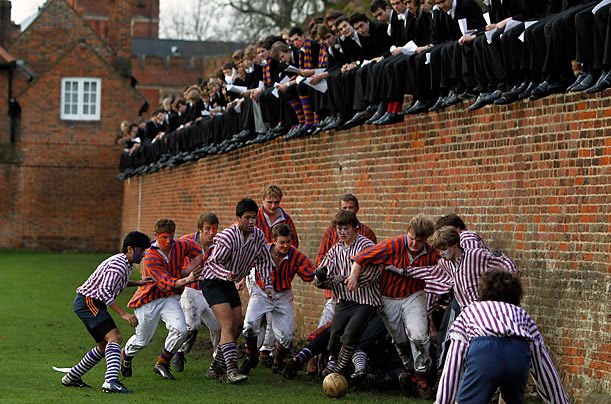
No. 1: The Eton Wall Game. I promised more Eton, didn't I? Every year on St. Andrew's Day, the Collegers (students on scholarship) play the Oppidans (everyone else) in another unique game similar to rugby or soccer. The field is 5 meters wide and 110 meters long. And bordered on one side by a slightly curved wall. Which means the side of the scrum (called a 'Bully') is always brushing up against the wall, on top of which fans - in their coats and tails, of course - sit. To the uninitiated the game simply looks like a lot of pushing, but in fact it requires a high degree of skill and a great deal of stamina. In spite of there being only 70 Collegers and about 1250 Oppidans, the Collegers have managed to hold their own over the years. And there have been plenty of years, with the first recorded game coming in 1844. His Royal Highness Prince Henry participated in the Wall Game and did rather well for himself. Here is a little clip from the 1921 game, for your viewing pleasure: