Saturday 11 April 2015 is The Boat Race, the annual competition between Oxford and Cambridge on the Thames. In the world of rowing, not to mention Oxbridge rivalry, it is as big as the Olympics. And after last year's drubbing by Oxford, Cambridge has something to prove.
You can watch the Boat Race - or, rather, Races, since the men and women are rowing on the same day this year - online, courtesy of the BBC. The women's race is at 16:50 (London time) and the men at 17:50.
To get in the mood, you might consider watching True Blue, a film based on the 1987 "Oxford Mutiny" and the Boat Race of that year.
Showing posts with label sports. Show all posts
Showing posts with label sports. Show all posts
Friday, April 10, 2015

Tuesday, July 20, 2010
Top Five (slightly obscure) Sporting Events I'd Like to See
 No. 5: The Eton Field Game. This is not a single event, but a highly specialized sport all its own. The Eton Field Game is two parts soccer, and one part rugby, with a huge dose of preppy. Played only at Eton College, the game has been going on since at least 1815 and is played by virtually all the boys at the school. But the Field Game comes in only at no. 5 both because it is not a single event and because better things await us at Eton...
 No. 4: King's Cup Elephant Polo. Believe it or not, elephant polo is a real sport, complete with its own world governing body. Details of the international elephant polo scene are hard to come by, but the game is played in India, Nepal, Sri Lanka, Thailand and the UK. If at times a little, um, lumbering... the game can also be quite dangerous. In any case, the King of Thailand hosts a tournament each year, which I need to see one of these days.
 No. 3: The Boat Race. This is the least obscure of any of these. Watched by tens of millions of people around the world each year, the annual rowing competition between Oxford and Cambridge down the River Thames is arguably the biggest event for the sport, even bigger than the Olympics. The race was first held in 1829 and has been held every year - with the exception of the World Wars - since 1856. The race has been highly competitive over the years, with Oxford winning 75 and Cambridge 80. The course, 4 miles and 374 yards long, is quite lengthy (three times the length of the World Rowing Championship race), exhausting for the participants. Moreover, the race is carried out close enough to the mouth of the Thames that not only the current and wind but also the tide are factors; thus, teams compete for the best position on the river, often clashing blades before the umpire warns them apart. Lest you think this is just a boat race, let me recommend you watch True Blue, a film about the 1987 race. Oh, and the rowers: they're students too. Some of them even complete degrees including PhDs in Mathematics, or Bioinformatics or an MD in Clinical Neurology.
 No. 2: The St. John's - Naval Academy Croquet Match. Yes, you read that right: St. John's College, that stronghold of classical education and extreme nerdery, plays the US Naval Academy in croquet each year. Apparently the students of St. John's once discovered that the midshipmen's code prevents them from turning down an official challenge to their honor. So the geeks of St. John's put their heads together and thought of a contest they might just win. The event - featuring outrageous clothing on the part of the St. John's team and fans - has continued for nearly three decades now.
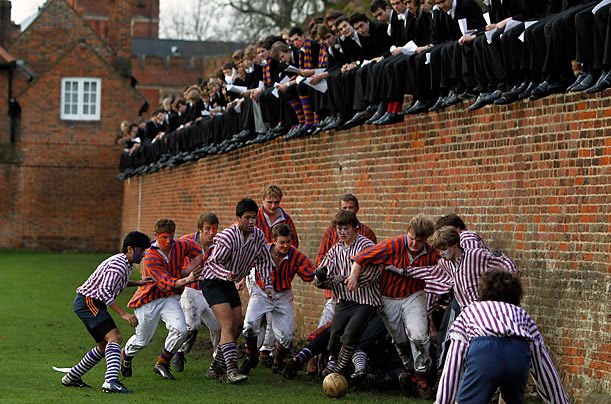 No. 1: The Eton Wall Game. I promised more Eton, didn't I? Every year on St. Andrew's Day, the Collegers (students on scholarship) play the Oppidans (everyone else) in another unique game similar to rugby or soccer. The field is 5 meters wide and 110 meters long. And bordered on one side by a slightly curved wall. Which means the side of the scrum (called a 'Bully') is always brushing up against the wall, on top of which fans - in their coats and tails, of course - sit. To the uninitiated the game simply looks like a lot of pushing, but in fact it requires a high degree of skill and a great deal of stamina. In spite of there being only 70 Collegers and about 1250 Oppidans, the Collegers have managed to hold their own over the years. And there have been plenty of years, with the first recorded game coming in 1844. His Royal Highness Prince Henry participated in the Wall Game and did rather well for himself. Here is a little clip from the 1921 game, for your viewing pleasure:
Sunday, June 28, 2009
Sports and Catharsis
Is it possible to find catharsis through sport, as we do through art?
This question popped into my mind as I watched the Cubs-White Sox game on Saturday, and I felt compelled to consider some of the similarities between watching a sports game and going to the theater.
Both a good game and a good play (note even the similarity in language) draw the spectator into the action, making him forget about everything else around him. Both a game and a play are self-contained worlds, which allow us to reflect on our own lives. Interestingly enough, in ancient Greece both athletics and drama began as parts of religious festivals.
Moreover, as a life-long, long-suffering Cubs fan, I'm thoroughly convinced that baseball has taught me all I'll ever need to know about tragedy. What can you say about a team that has not won a championship in over 100 years, despite many excellent teams and many outstanding opportunities? The Cubs' woes easily compare with those of a Greek tragedy. Babe Ruth called his famous home run shot at Wrigley Field to defeat the Cubs in the 1932 World Series. Thebes suffered under the Sphinx, and Chicago has been cursed by the billy goat. (One important difference, though, is that while many Cubs fans unwind at the famous Billy Goat Tavern, Thebans probably didn't go out for drinks at the Taberna Sphinx.) Only just recently, it was revealed that the Cubs' most recent hero, Sammy Sosa, owed many of his home runs to performance-enhancing drugs. A great man's ambition becomes his tragic flaw. Clearly, the Cubs' history bears all the mark of a Greek tragedy.
If this all sounds a bit too fantastic, if you don't believe the Cubs deserve to be compared to Oedipus and Orestes, or Chicago to Thebes and Mycenae, you must still admit that the Cubs' misfortunes are at least worthy of an Old World folk tale. There's the black cat at Shea Stadium that caused the Cubs' promising 1969 season to fall apart in the last month. There's the story that it was Bill Buckner's old Cubs batting glove which caused him, even as a member of the Red Sox, to let a ground ball go through his legs in the World Series. There's no arguing--this is all empirically verifiable fact!
 Well, to be a little more serious...My basic point is that I don't understand the snobbishness of people who look down on pro sports. After all, many of these self-appointed snobs, who think of theater, ballet, and classical music as the only serious arts, make the same objections to professional sports that many ancient philosophers (e.g., Plato in the Republic) made against theater-goers: rowdy, drunk, concerned only with images, etc. These accusations are not entirely unfounded, but they should not take away from the glory of sport.
Sport illuminates the experience of victory and defeat better than any play. The intense effort, the grand hopes, and the dejection of defeat--these are all things which we see most clearly in a closely-contested sporting match. That, I'm sure, is why St. Paul chose to compare life as a Christian to a race and a fight (2 Tim. 4:7).
This question popped into my mind as I watched the Cubs-White Sox game on Saturday, and I felt compelled to consider some of the similarities between watching a sports game and going to the theater.
Both a good game and a good play (note even the similarity in language) draw the spectator into the action, making him forget about everything else around him. Both a game and a play are self-contained worlds, which allow us to reflect on our own lives. Interestingly enough, in ancient Greece both athletics and drama began as parts of religious festivals.
Moreover, as a life-long, long-suffering Cubs fan, I'm thoroughly convinced that baseball has taught me all I'll ever need to know about tragedy. What can you say about a team that has not won a championship in over 100 years, despite many excellent teams and many outstanding opportunities? The Cubs' woes easily compare with those of a Greek tragedy. Babe Ruth called his famous home run shot at Wrigley Field to defeat the Cubs in the 1932 World Series. Thebes suffered under the Sphinx, and Chicago has been cursed by the billy goat. (One important difference, though, is that while many Cubs fans unwind at the famous Billy Goat Tavern, Thebans probably didn't go out for drinks at the Taberna Sphinx.) Only just recently, it was revealed that the Cubs' most recent hero, Sammy Sosa, owed many of his home runs to performance-enhancing drugs. A great man's ambition becomes his tragic flaw. Clearly, the Cubs' history bears all the mark of a Greek tragedy.
If this all sounds a bit too fantastic, if you don't believe the Cubs deserve to be compared to Oedipus and Orestes, or Chicago to Thebes and Mycenae, you must still admit that the Cubs' misfortunes are at least worthy of an Old World folk tale. There's the black cat at Shea Stadium that caused the Cubs' promising 1969 season to fall apart in the last month. There's the story that it was Bill Buckner's old Cubs batting glove which caused him, even as a member of the Red Sox, to let a ground ball go through his legs in the World Series. There's no arguing--this is all empirically verifiable fact!
 Well, to be a little more serious...My basic point is that I don't understand the snobbishness of people who look down on pro sports. After all, many of these self-appointed snobs, who think of theater, ballet, and classical music as the only serious arts, make the same objections to professional sports that many ancient philosophers (e.g., Plato in the Republic) made against theater-goers: rowdy, drunk, concerned only with images, etc. These accusations are not entirely unfounded, but they should not take away from the glory of sport.
Sport illuminates the experience of victory and defeat better than any play. The intense effort, the grand hopes, and the dejection of defeat--these are all things which we see most clearly in a closely-contested sporting match. That, I'm sure, is why St. Paul chose to compare life as a Christian to a race and a fight (2 Tim. 4:7).
Monday, March 23, 2009
The Boat Race
 This coming Sunday will be the 155th Boat Race. If you find yourself asking, "Which boat race?" please click here. The rest of you know that it is simply the Boat Race, the competition between Oxford and Cambridge, first held in 1829 and annually since 1856 (with the exception of the World Wars), down four and a quarter miles of the River Thames, from the Putney Bridge to the Chiswick Bridge. Cambridge has won 79 of the races, Oxford 74, with one declared a dead heat.
This past weekend the Financial Times had an excellent article on Rebecca Dowbiggin, the Cambridge coxswain. This year's race will be at 3:40pm (British Standard Time), so I might still be at mass while the actual race is happening, but I look forward to watching it online shortly thereafter.
To be honest, I don't really have a dog in this fight. I will, however, be wearing my Caius College tie, in honor of Silas Stafford, a native of Santa Rosa, California, who is studying for an MPhil in Geography at Gonville & Caius and will be rowing stroke for the Cambridge team. I wore that tie the day Caius won their fifth consecutive Lent Bumps, earning them the right to put a bell tower on their boat house, so maybe the tie is lucky. Then again, 1st & 3rd Trinity have won that race every year since then, so maybe it's not.
Below you'll find a video about the Trial Eights, the trial run each school conducts in December.
Special thanks to Barry Arthur Stephen Harding McCain, who gave me the Caius tie.
Tuesday, December 2, 2008
On Japanese Soccer Culture
The Financial Times recently had a very interesting article on soccer in Japan, which has one of the best teams in Asia, if not the best. Some of the article related the ups and downs of particular players and matches, but the part I found most interesting was about the fans:
 Football existed in Japan before 1993 but not in a meaningful way. Before the J League was inaugurated, Saburo Kawabuchi, the head of the Japanese football federation, sent researchers round the globe to report back on issues such as fan behaviour, tactics and marketing.
The odd thing was that Philippe Troussier, their French coach, seemed oddly gloomy throughout the tournament. On a windswept terrace at their Beirut hotel, he gave the sort of despairing, dyspeptic interview that usually indicates a manager is coming to the end of his tether.
Japan had no football culture, he moaned. There was none of the ruthless desire to win he had experienced during his years coaching in Africa....
 Football existed in Japan before 1993 but not in a meaningful way. Before the J League was inaugurated, Saburo Kawabuchi, the head of the Japanese football federation, sent researchers round the globe to report back on issues such as fan behaviour, tactics and marketing.
In the short term, it worked – the J League boomed and the national team was set on its way to Asian supremacy.
The problem, though, is that what began as mimicry has remained just that – it has not taken root and become organic. Kawabuchi has spoken of fans losing their inhibitions when they enter a stadium, taking on different national characteristics in the style of their support. “They are Japanese living in their own country,” he said, “who have abandoned a little of their Japaneseness.”
But that is the issue: fans put on great shows of colour and noise that are impressive until the game starts, at which it becomes apparent that their spectacle is divorced from what is happening on the pitch: a goal is scored against a team, and their fans carry on their song without missing a beat.
Shunsuke Nakamura (pictured), Celtic’s Japanese winger, made the point indirectly in speaking of his love for the fans in Glasgow. “They let the players raise their level,” he said. “They’re amazing. Their cheers change in response to the play.” Which, implicitly, is not the case in Japan.
It is fandom learnt by rote.
Subscribe to:
Posts (Atom)